
In a digital age dominated by technology, the alarming rise of cybercrime has surpassed all expectations, reaching a staggering annual cost of $8.15 trillion. This figure, unveiled by a recent Statista Market Insights survey, not only dwarfs the revenues of the world's largest corporations but also underscores the pervasive threat posed by cybercriminals to businesses and governments worldwide.
To put this colossal sum into perspective, consider this: cybercrime's annual income outstrips that of behemoths like Woolworths, Coles, Amazon, Apple and Pfizer combined. While these corporate giants collectively rake in over $2 trillion, cybercrime's illicit economy looms ominously, casting a shadow over the digital landscape.
The $8.15 trillion encompasses the damages wrought by a myriad of cyberattacks, ranging from ransom payouts and lost productivity to system downtimes and data theft. What was once perceived as a fringe activity has now evolved into a highly sophisticated global enterprise, with cybercriminals leveraging advanced techniques and collaborative networks to wreak havoc on unsuspecting victims.
Carlos Salas, a cybersecurity expert at NordLayer, emphasizes the evolution of cybercrime, stating, "Some still believe a typical hacker is just a guy wearing a hoodie in a dark room. But that isn’t true anymore. Cybercrime has evolved into a professionalized global enterprise with skilled hackers, nation-state backed groups, and organized cybercrime rings working in tandem."
The modus operandi of cybercriminals revolves around two primary illicit business models: selling stolen data on dark web marketplaces and executing ransomware attacks. These nefarious activities involve infiltrating systems to pilfer personal and financial data, including login credentials and corporate secrets, which are then peddled to other threat actors, fueling crimes like identity theft, payment fraud, and corporate espionage.
Ransomware, in particular, has emerged as a potent weapon in the cybercriminal arsenal, allowing hackers to encrypt an organization's systems and data, effectively holding them hostage until a ransom fee is paid. The repercussions of ransomware attacks have been felt across diverse industries and governmental bodies, with cybercriminals extorting millions in ill-gotten gains. What was once a clandestine operation has now transformed into a lucrative criminal enterprise, with ransomware operators leasing malware and orchestrating ransom negotiations through sophisticated infrastructures.
Carlos Salas sheds light on the allure of cybercrime, stating, "With relatively low entry costs but higher income than traditional crimes, it’s no surprise cybercrime has become such an attractive criminal pursuit. There’s less physical risk than, say, burglary or armed robbery. With so much valuable data and systems to target across businesses, cybercrime has become a highly profitable illegal industry."
As the digital landscape continues to evolve, the battle against cybercrime intensifies. Businesses and governments must remain vigilant, investing in robust cybersecurity measures and fostering collaboration to thwart the ever-evolving tactics of cybercriminals. Only through collective action and unwavering commitment can we hope to stem the tide of cybercrime and safeguard the digital realm for generations to come.
Being mindful of potential risks to your personal details, vetting providers and the use of products such as Site Lock, robust and intelligent spam filtering services or SSL Certificates can assist you and your clients to stay safe online and avoid being trapped by online criminal organisations.
Get in touch with Hosting Australia today to discuss your options.
Welcome to our crash course on web hosting for small business owners. As a small business with an online presence, choosing the right web host is crucial. It can make all the difference in the performance, security, and affordability of your website. In this article, we will guide you through the essential factors to consider when selecting a web host for your small business. Hosting Australia is a full service hosting provider and can provide all the services and advice you need
Key Takeaways:
What to Look for in a Small Business Web Host
When it comes to choosing a web host for your small business, it's crucial to consider several factors to ensure you make the right decision. Here are some key points to keep in mind:
Good customer service is essential when dealing with web hosting. Look for a provider that offers 24/7 support, quick response times, and knowledgeable staff. This will ensure that you have assistance whenever you need it, minimizing any potential downtime or issues that may arise.
Reliability is another critical aspect to consider. Check the host's track record for uptime and data protection. Look for reviews and testimonials from other customers to get an idea of their experience with the hosting provider. A reliable host will ensure that your website is always accessible to visitors and that your data remains secure.
Consider the amount of disk space offered by the hosting provider and whether it meets your current and future needs. Small businesses may start with a basic website, but as they grow, they may need additional space for more content or features. It's important to choose a hosting solution that offers scalability and flexibility to accommodate future growth.
Look for hosting providers that offer additional features that can enhance your website management experience. This could include intuitive control panels for easy navigation, one-click installation of platforms like WordPress, and website builders that simplify the design process. Automated backups, one-click software updates, and email account management are also crucial features to consider.
By considering these factors, you can ensure that you choose the best web host for your small business, providing a reliable and secure online presence.
Ensuring Website Security and Performance
When it comes to small business web hosting, security and performance are two crucial factors that should not be overlooked. Your website's security is of utmost importance to protect your business and your customers' data. Look for web hosting providers that offer secure hosting services, including features like SSL certificates and secure file transfer options. This ensures that data transmitted between your website and your visitors is encrypted and protected from potential threats.
In addition to security, website performance is another key consideration. A fast-loading website not only provides a better user experience but also contributes to higher search engine rankings. Look for hosting providers that offer performance optimization features, such as caching mechanisms and content delivery networks (CDNs). These technologies help deliver your website content quickly to visitors all over the world, reducing loading times and improving overall performance.
Cost-effectiveness is another aspect to consider when choosing a web host. While security and performance optimization are important, they should come at a reasonable cost. Compare the pricing plans of different hosting providers and evaluate the features and benefits they offer. Look for providers that offer affordable plans while still meeting your security and performance needs.
In summary, when selecting a web hosting service for your small business, prioritize security, performance, and cost-effectiveness. Choose a provider that offers secure hosting services with features like SSL certificates and secure file transfer options. Look for performance optimization features like caching mechanisms and content delivery networks to ensure fast-loading websites. Finally, compare pricing plans to find a cost-effective solution that suits your business requirements.
Managing Your Website with Ease
When it comes to managing your website, simplicity and usability are key. As a small business owner, you want to focus on running your business, not getting bogged down in complicated technical processes. That's why it's important to choose a web hosting service that offers professional features and tools to make website management a breeze.
One of the factors to consider when selecting a web host is the user-friendly interface and management tools they provide. Look for a hosting provider that offers an intuitive control panel, which allows you to easily navigate and manage your website settings. With a user-friendly interface, you can effortlessly perform tasks like domain management, email account setup, and website backups.
Moreover, consider a hosting provider that offers easy installation of popular platforms like WordPress. This will allow you to quickly set up your website and start customizing it to your liking. Additionally, look for web hosts that provide website builders, which are especially useful if you don't have web development experience. These builders offer pre-designed templates and drag-and-drop functionality, making it simple to create a professional-looking website.
Furthermore, automated backups are a crucial feature to look for in a web hosting service. Regular backups ensure that your website's data is protected and can be easily restored in the event of any issues or data loss. Another convenience to consider is one-click software updates. This feature allows you to easily update your website's software and plugins, ensuring that your site remains secure and up to date without any hassle.
Cost Considerations and Future Growth
When it comes to web hosting for small business, affordability is a crucial factor. As small business owners, we understand the importance of finding a hosting provider that offers reliable service at an affordable price. That's why we recommend comparing the pricing plans of different hosting providers to find the best fit for your budget and needs.
While it's essential to keep costs in mind, it's equally important to consider the potential for future growth. As your business expands, your website's demands may increase. Look for a hosting solution that offers scalability, allowing you to easily upgrade your hosting plan as your traffic and storage requirements grow.
Don't forget to explore any special offers or bundled services that hosting providers may offer. Some providers provide introductory discounts or package deals that can help you save money while still enjoying reliable service. By planning for the long-term and considering your budget and growth goals, you can make a wise investment in your small business's online presence.
A website marketing strategy plays a crucial role in the success of small businesses in Australia. It allows businesses to connect with potential customers, attract, engage, and convert browsers into buyers. Creating a powerful website marketing strategy can be challenging, but by following a step-by-step process, small businesses can achieve their goals. This includes conducting thorough research to understand themselves and their target customers, auditing their website to ensure it delivers a positive user experience, leveraging the power of Google to drive targeted traffic, and creating high-quality content that resonates with their audience. It's important to optimize the website for search engines with the right keywords, focus on producing valuable and relevant content, and utilize social media and email marketing to connect with the audience effectively.
Key Takeaways:
Step 1: Research: Know Yourself and Your Customer
Conducting comprehensive research is the first step in creating a successful website marketing strategy. As small businesses, it's essential to understand what sets us apart from our competitors and identify our unique selling proposition (USP). By researching our target customers, we can gain valuable insights into their wants, needs, and preferences. This knowledge will help us craft a marketing strategy that effectively reaches and engages our customers.
Market research plays a crucial role in understanding our industry and identifying trends that can impact our business. By staying informed about our competitors, we can analyze their strategies, identify gaps in the market, and differentiate ourselves. This competitive analysis allows us to position our business effectively and tailor our marketing messages to stand out.
Knowing our business goals and understanding our target customers is the foundation of a successful website marketing strategy. With thorough research and analysis, we can develop a strategy that speaks directly to our audience, addresses their pain points, and delivers results.
Benefits of Step 1: Research
Example Quotes:
"Research is the backbone of any successful marketing strategy. It helps us understand our customers, our industry, and our competitors. With these insights, we can create targeted and impactful marketing campaigns that resonate with our audience."
"By conducting thorough research, we can uncover opportunities and gaps in the market. This knowledge allows us to differentiate ourselves, position our business effectively, and gain a competitive edge."
| Research Steps | Purpose |
| Identify unique selling proposition (USP) | To differentiate ourselves from competitors |
| Understand target customers | To tailor marketing messages and meet their needs |
| Analyze industry trends and competitors | To identify opportunities and gaps in the market |
| Position the business effectively | To stand out and attract the right customers |
By conducting thorough research and gaining insights into our business, industry, target customers, and competitors, we can lay a strong foundation for our website marketing strategy. This knowledge will guide our decision-making process and ensure that our marketing efforts are focused, targeted, and effective.
Step 2: Audit Your Website
Auditing the website is a critical step in crafting a winning website marketing strategy. A user-friendly website design and navigation play a crucial role in delivering a positive user experience and building trust with potential customers. By ensuring that your website is accessible, visually appealing, and trustworthy, you can create a compelling online presence that resonates with your target audience.
Evaluating Website Design and Navigation
When auditing your website, it's essential to assess its design and navigation elements. A visually appealing design with a cohesive color scheme, well-chosen fonts, and high-quality images can capture visitors' attention and lend credibility to your brand. Additionally, intuitive navigation allows users to find the information they need quickly and easily, enhancing their overall experience on your website.
Consider evaluating the placement and visibility of key elements such as your logo, menu options, search bar, and contact information. Ensuring that these elements are easily accessible can help visitors navigate your site effortlessly and encourage them to engage with your business.
Ensuring Mobile Optimization and Fast Loading Speeds
In today's digital landscape, mobile optimization is crucial. With a growing number of users accessing websites on their smartphones and tablets, it's essential to ensure that your website is responsive and displays correctly across all devices. By offering a seamless experience on mobile, you can cater to a broader audience and increase your chances of converting visitors into customers.
Furthermore, website loading speed is a critical factor in user satisfaction. Slow-loading websites can frustrate users and drive them away. To enhance loading speeds, consider optimizing image sizes, minimizing the use of plugins, and leveraging browser caching techniques. These optimizations can improve your website's performance, keeping visitors engaged and reducing bounce rates.
| Key Elements to Assess during Website Audit | Actions to Enhance User Experience |
| Website design and color scheme | Ensure visually appealing and cohesive design elements |
| Navigation structure | Make navigation intuitive and easily accessible |
| Responsiveness and mobile optimization | Ensure the website displays correctly on all devices |
| Loading speed | Optimize images and minimize plugins for faster page loading |
| Trustworthiness indicators (security certificates, customer testimonials) | Showcase trust elements to build credibility and instill confidence |
Building Trust with Website Trustworthiness Indicators
Trustworthiness is a critical factor for online success. Incorporating trust indicators on your website can help build credibility and establish a strong foundation for customer relationships. Consider elements such as security certificates, customer testimonials, verified badges, and privacy policies to assure visitors of the safety and reliability of your website.
During the website audit, assess the presence and positioning of trust indicators on your website. Placing them strategically can boost visitors' confidence in your brand and increase the likelihood of them engaging with your business.
By auditing your website, you can identify areas for improvement and ensure a user-friendly experience that aligns with your marketing goals. Take the time to assess design, navigation, mobile optimization, loading speed, and trustworthiness indicators to maximize the impact of your website marketing strategy.
Step 3: Leverage the Power of Google
Now that we have conducted thorough research and audited our website, it's time to leverage the power of Google to drive targeted traffic. By utilizing effective keyword research, search engine optimization (SEO), and creating high-quality content, we can improve our website's visibility and attract the right audience.
Keyword Research: Targeted Traffic Starts with the Right Keywords
Keyword research is key to understanding what our target audience is searching for and identifying the most relevant keywords to optimize our website. By using tools like Google Keyword Planner or SEMrush, we can discover valuable insights into search volume, competition, and related keywords. This allows us to strategically incorporate these keywords in our website's content, meta tags, and headers, improving our organic rankings and attracting targeted traffic.
Search Engine Optimization: Optimize for Visibility
Optimizing our website for search engines is crucial to ensure that it is not only visible but also easily discoverable by our target audience. By implementing on-page SEO techniques such as optimizing meta titles and descriptions, using header tags, and creating descriptive URLs, we can improve our website's visibility in search engine result pages (SERPs). Additionally, optimizing technical aspects like site speed and mobile responsiveness can enhance the user experience, ultimately leading to higher rankings and increased targeted traffic.
High-Quality Content: Engage and Convert Visitors
Creating high-quality content that resonates with our audience is essential for attracting and engaging targeted traffic. By addressing the needs, challenges, and interests of our target audience through informative blog posts, engaging videos, or valuable downloadable resources, we can position ourselves as industry experts and build trust with our visitors. This not only increases the time users spend on our website but also encourages them to take desired actions, such as making a purchase or subscribing to our newsletter.
While leveraging the power of Google is crucial, it's important to remember that targeted traffic is just the first step. Once we have successfully attracted visitors to our website, our next step is to focus on creating content that captivates and converts them into loyal customers.
| Benefits of Leveraging Google | Key Strategies |
| Increased website visibility | Effective keyword research |
| Higher organic rankings | Search engine optimization |
| Targeted traffic | Optimizing technical aspects |
| Improved user experience | Creation of high-quality content |
Step 4: Create Content that People Love
Content marketing is a powerful strategy that allows small businesses to attract and engage their target audience effectively. By creating targeted content that addresses the specific needs and interests of their customers, businesses can build trust, establish thought leadership, and drive valuable actions. Whether it's informative articles, engaging videos, interactive webinars, insightful ebooks, or visually appealing infographics, the key is to deliver content that people love.
To ensure that your content reaches the right audience, it's important to promote it through social media marketing. Identify the platforms where your target audience gathers and share your content there. Engage with your audience, respond to their comments, and encourage them to share your content with their networks. This not only increases your content's visibility but also helps in building brand awareness and driving website traffic.
Another effective strategy is email marketing. Segment your email list based on demographics, interests, or buying behavior to deliver personalized content directly to your audience's inbox. Automate the process to send timely and targeted messages, such as promotions, product updates, or newsletters. By nurturing leads and building customer relationships through email marketing, you can turn prospects into loyal customers.
In conclusion, content marketing, combined with social media marketing and email marketing, plays a crucial role in the success of small businesses. By creating targeted content that resonates with your audience, promoting it strategically, and delivering personalized messages, you can build lasting relationships, drive website traffic, and achieve your business goals.
At Hosting Australia, we understand the critical role that uptime plays in the success of small business websites. It's not just about having an online presence, but also ensuring that your website is accessible and functional round the clock. In today's digital age, where customers expect instant information and seamless experiences, downtime can have serious consequences for your business.
When your website is down, it n ot only damages your professional image but also leads to unhappy customers and potential loss of sales or leads. Moreover, downtime can negatively impact your search engine rankings and increase the risk of security breaches.
That's why having a reliable uptime monitoring service is crucial. We offer a variety of server monitoring tools for our hosted clients, designed to ensure your website's 24/7 online presence. With features like website performance monitoring, mobile website monitoring, Googlebot health check, page content monitoring, and 1-minute monitoring, we help you stay ahead of any potential downtime issues.
Key Takeaways:
The Implications of Website Downtime for Small Businesses
Website downtime can have significant consequences for small businesses, impacting their professional reputation, customer satisfaction, and overall revenue. When a website is unavailable or experiences performance issues, it can lead to frustrated customers, lost sales, and missed opportunities. Therefore, finding reliable web hosting solutions is crucial for small businesses to minimize the risk of downtime and ensure a seamless online experience for their customers.
"Downtime is every business owner's worst nightmare. It not only affects your sales and revenue but also damages your credibility and customer trust."
One of the key considerations for small businesses when choosing a web hosting provider is reliability. Investing in cheap web hosting options may seem enticing from a cost perspective, but it often comes at the expense of uptime and customer support. Opting for top web hosting providers that offer reliable services and prioritize uptime can save small businesses from the negative impacts of downtime. These providers often have robust infrastructure, redundant systems, and proactive monitoring to detect and resolve issues before they cause significant disruptions.
Additionally, small businesses should look for web hosting solutions that offer comprehensive support and provide proactive measures to address downtime. This includes features like automatic backups, 24/7 customer support, and regular software updates to enhance website performance and security. By selecting the right web hosting options for small businesses, entrepreneurs can focus on growing their ventures without the constant worry of website downtime.
The Impact of Downtime on Small Businesses
Table 1 provides an overview of the implications of website downtime for small businesses:
| Implications of Website Downtime | Description |
| Damage to Professional Reputation | Downtime can create a negative impression of the business, leading to decreased trust and credibility among customers. |
| Loss of Sales and Revenue | Inaccessible websites result in missed opportunities and potential customers turning to competitors. |
| Customer Dissatisfaction | Website downtime frustrates customers and may result in them seeking alternative options. |
| Negative Impact on SEO Rankings | Consistent downtime can harm search engine rankings, making it harder for potential customers to find the business online. |
| Increased Security Risks | Outdated software and vulnerabilities during downtime can make the website an easy target for hackers. |
As evident from the table, website downtime can have severe consequences for small businesses. It is crucial for entrepreneurs to prioritize reliable web hosting solutions and regularly monitor their websites to mitigate the risks associated with downtime. By investing in top web hosting options and implementing proactive measures, small businesses can maintain a strong online presence, maximize customer satisfaction, and drive business growth.
Understanding Website Uptime and Its Metrics
Website uptime is a critical aspect of maintaining a successful online presence. It refers to the amount of time that a website is fully operational and accessible to users. Monitoring website uptime metrics is essential for small businesses to ensure optimal website performance and prevent downtime. Let's explore some key metrics that contribute to website uptime:
Server Health
The health of your server plays a crucial role in website uptime. Regular monitoring of server hardware, software, and network infrastructure helps identify any potential issues that could lead to downtime. By monitoring server health metrics such as CPU usage, memory utilization, and disk space, you can proactively address any performance bottlenecks and ensure a smooth user experience.
Hosting Performance
The performance of your web hosting provider directly impacts your website's uptime. Monitoring hosting performance metrics, such as server response time and page load speed, helps identify any issues that may lead to slow or unresponsive websites. By measuring these metrics, you can work with your hosting provider to optimize performance and ensure consistent uptime.
DNS
The Domain Name System (DNS) is responsible for translating domain names into IP addresses, allowing users to access websites. Monitoring DNS uptime and response time is crucial to ensure that users can reliably reach your website. By using DNS monitoring tools, you can identify and address any DNS-related issues that may impact website availability.
Other important metrics to consider for website uptime monitoring include website content, SSL certificate expiration, database performance, third-party services and integrations, and security and vulnerability scanning. Monitoring these metrics helps identify potential vulnerabilities, performance bottlenecks, or integration issues that could impact website uptime.
| Metric | Description |
| Website Content | Regularly check for broken links, missing images, or outdated content that may affect user experience and search engine rankings. |
| SSL Certificate Expiration | Monitor SSL certificate validity to ensure secure connections between your website and users. |
| Database Performance | Optimize database queries and monitor performance to prevent slowdowns or crashes. |
| Third-Party Services and Integrations | Ensure seamless integration with external services and monitor their uptime to prevent disruptions. |
| Security and Vulnerability Scanning | Regularly scan your website for vulnerabilities and address any security risks that could lead to downtime. |
By monitoring these various metrics, small businesses can maintain a high level of website uptime, providing a seamless user experience and ensuring the success of their online ventures.
The Importance of Monitoring Website Uptime
Monitoring website uptime is crucial for small businesses to ensure minimal downtime and maximum reliability. Downtime duration, error rates, and HTTP status codes provide valuable insights into website reliability and infrastructure issues. Additionally, response time is a crucial metric that directly affects user experience and bounce rate. By implementing a comprehensive uptime monitoring strategy, small businesses can proactively identify and resolve issues, ultimately improving overall website performance and uptime.
One of the key metrics to consider when monitoring website uptime is the duration of downtime. This metric measures the amount of time your website is inaccessible to users. By closely monitoring downtime duration, you can identify patterns and potential causes, allowing you to take swift action to minimize its impact and restore your website's availability. Identifying and addressing high error rates is also crucial, as it indicates potential stability and functionality issues that may result in extended periods of downtime.
HTTP status codes, such as 404 (Not Found) or 500 (Internal Server Error), provide valuable information about the status of your website's pages. By regularly monitoring these codes, you can quickly detect any issues that may arise and take the necessary steps to rectify them. A fast and responsive website is essential for a positive user experience. Monitoring response time helps ensure that your website is loading quickly and efficiently, minimizing the risk of users abandoning your site due to slow performance.
Implementing an effective uptime monitoring strategy involves utilizing a combination of tools and techniques to gather and analyze relevant data. By regularly monitoring these metrics and promptly addressing any issues that arise, you can maintain optimal website performance, enhance user satisfaction, and ultimately drive business growth.
Choosing the Right Uptime Monitoring Tools for Small Businesses
When it comes to ensuring website uptime, small businesses need reliable monitoring tools. With a variety of options available, it's important to choose the right one based on your specific needs. Whether you're looking for a free monitoring version or a premium or enterprise solution, there are tools out there to suit every requirement.
One popular option is Summing Up, a comprehensive website monitoring tool that offers a range of features to keep your website running smoothly. Monitis, Pingdom, and Site24x7 are also trusted names in the industry, providing robust monitoring solutions for small businesses.
In addition to uptime monitoring, it's crucial to track SSL certificate expiration and optimize website database performance. By monitoring these aspects, you can prevent potential issues that may impact your website's availability.
Furthermore, it's important to keep an eye on third-party services and integrations, as well as employing security and vulnerability scanning tools. These measures help safeguard your website and ensure continuous uptime for your business.
Embracing cloud computing can enable small businesses to overcome limitations and drive growth. Cloud computing allows businesses to access data and run applications over the internet, eliminating the need for physical infrastructure. This article will explore the benefits and impact of cloud hosting solutions for small businesses, focusing on web hosting for small business and how it can contribute to small business prosperity.
Key Takeaways:
The Benefits of Cloud Computing for Small Businesses
Cloud computing offers several advantages for small businesses. It allows for cost savings by eliminating the need for expensive hardware and infrastructure. With cloud hosting solutions, small businesses can reduce upfront costs and eliminate the need for physical servers and data centers. Instead, they can rely on cloud service providers to handle their computing needs, saving money on maintenance and upgrades.
Scalability is another key benefit of cloud computing. Small businesses can easily scale their resources up or down as their needs change. Whether they experience a sudden surge in demand or need to downsize during quieter periods, cloud hosting solutions allow for flexibility and adaptability. This not only saves money by avoiding unnecessary resource allocation but also ensures that businesses can meet their customers' demands effectively.
"Cloud hosting provides reliable and secure data storage and protection, ensuring business continuity and minimizing the risk of data loss."
When it comes to reliability and security, cloud hosting delivers peace of mind for small businesses. Cloud service providers offer robust data storage and protection measures, including encryption, regular backups, and disaster recovery plans. Small businesses can rely on these measures to ensure business continuity and minimize the risk of data loss. With the right cloud hosting solution, they can confidently store and access their data, knowing that it is protected against cyber threats and potential hardware failures.
Table: Comparison of Cost, Scalability, Reliability, and Security
| Cost | Scalability | Reliability | Security | |
| Traditional On-Premises | Expensive upfront costs for hardware and infrastructure | Limited scalability, requires additional investments for expansion | Dependent on in-house IT team for maintenance and updates | Maintenance of security measures falls on the business |
| Cloud Hosting | Cost savings by eliminating hardware and infrastructure expenses | Easily scalable, resources can be adjusted based on needs | Reliable data storage, regular backups, and disaster recovery plans | Cloud service providers offer robust security measures |
In conclusion, cloud computing brings significant benefits to small businesses. It enables cost savings, scalability, reliability, and enhanced security. By embracing cloud hosting solutions, small businesses can focus on their core operations and growth, knowing that their computing needs are met efficiently and securely.
How Cloud Computing Empowers Small Businesses
Cloud computing has become an essential tool for small businesses, providing numerous benefits that enhance productivity and efficiency. By embracing cloud technology, businesses can leverage remote work and collaboration, access advanced technology, and streamline operations, resulting in increased success and growth.
Remote Work and Collaboration
Cloud computing enables small businesses to break free from traditional office settings and embrace remote work. Team members can access files and collaborate in real-time from any location, eliminating geographical barriers and fostering collaboration. This flexibility allows businesses to tap into a global talent pool and work with team members regardless of their physical location, resulting in increased productivity and efficiency.
Access to Advanced Technology
One of the key advantages of cloud computing is the access it provides to advanced technology that may have been otherwise unaffordable for small businesses. Cloud-based platforms offer a range of services, such as big data analytics and artificial intelligence, empowering businesses to leverage data-driven insights and automate processes. By harnessing these advanced technologies, small businesses can gain a competitive edge and drive innovation in their respective industries.
Improved Efficiency and Productivity
Cloud computing streamlines business operations by automating tasks and optimizing efficiency. With cloud-based solutions, businesses can automate routine processes, freeing up valuable time and resources. This automation enhances productivity as employees can focus on high-value tasks that drive growth and innovation. Additionally, cloud-based collaboration tools facilitate seamless communication and project management, ensuring that tasks are completed in a timely manner and fostering a culture of efficiency.
| Benefits of Cloud Computing for Small Businesses | Impact |
| Remote Work and Collaboration | Breaking geographical barriers and fostering global collaboration |
| Access to Advanced Technology | Leveraging data-driven insights and automation for innovation |
| Improved Efficiency and Productivity | Streamlining operations and optimizing resource allocation |
Implementing Cloud Computing in Small Businesses
When it comes to implementing cloud computing in small businesses, it is crucial to have a well-thought-out plan in place to ensure a smooth transition. The first step is to identify the specific needs and goals of the business. This involves assessing the current infrastructure, evaluating areas where cloud computing can provide the most value, and identifying any potential challenges that may arise.
Once the business needs have been identified, the next step is to choose the right cloud computing solution. There are various options available, from public clouds to private clouds and hybrid solutions. It is important to consider factors such as scalability, cost, security, and compatibility with existing systems. Conducting thorough research and seeking expert advice can help in making an informed decision.
Training employees and ensuring their adoption of the new cloud computing system is an essential part of the implementation process. Employees should be provided with comprehensive training on how to use the new system effectively and efficiently. This includes understanding the benefits of cloud computing, learning new software and tools, and adapting to new workflows. Regular communication and ongoing support are vital to encourage employee adoption and address any concerns or challenges that may arise along the way.
Challenges and Risks of Cloud Computing for Small Businesses
While cloud computing offers numerous benefits, it is important for small businesses to be aware of the challenges and risks associated with this technology. Security and privacy concerns can arise, and there is always a potential risk of downtime and data loss. However, with proper security measures, regular backups, and proactive monitoring, these risks can be mitigated.
Security and Privacy Concerns
When businesses shift their data and applications to the cloud, they entrust their sensitive information to a third-party service provider. As a result, there is always a degree of concern regarding data security and privacy. Small businesses must ensure that the cloud hosting provider they choose has robust security measures in place, including strong encryption protocols, firewalls, and access controls. It is also advisable to thoroughly review the provider's privacy policy and data handling practices to protect sensitive customer information.
Downtime and Data Loss Risks
Another challenge of cloud computing is the potential for downtime and data loss. While cloud providers strive to offer high availability and reliability, occasional system outages can still occur. This can result in temporary disruptions to business operations and customer experience. Additionally, there is always a minuscule chance of data loss due to hardware or software failures, human error, or external threats. To mitigate these risks, small businesses should choose a reputable cloud hosting provider with a proven track record of uptime and data protection. Regularly backing up data and implementing a disaster recovery plan are also crucial.
The Impact of AWS in the Cloud Hosting Landscape
Amazon Web Services (AWS) has significantly transformed the cloud hosting landscape with its versatile and comprehensive suite of services. The AWS ecosystem offers scalability and flexibility, empowering businesses to adapt to fluctuating demands and ensure uninterrupted operations. With AWS, small businesses can harness the power of the cloud to drive growth and innovation while maintaining a strong focus on security and compliance.
The scalability and flexibility of AWS are key factors in its impact on the cloud hosting landscape. Small businesses can easily scale their resources up or down based on their needs, allowing them to optimize costs and adapt to changing market conditions. With AWS, businesses can quickly provision additional resources during peak periods and scale back during quieter periods, ensuring efficient resource utilization and cost savings.
Ensuring Security and Compliance
Security and compliance are top priorities in the AWS ecosystem. AWS provides robust data protection and encryption protocols, ensuring that sensitive business data is safeguarded against unauthorized access and breaches. The AWS infrastructure is designed to meet strict security standards and comply with industry regulations, giving small businesses peace of mind when it comes to data security and regulatory compliance.
| Benefits of AWS in the Cloud Hosting Landscape |
| Scalability and Flexibility |
| Allows businesses to easily scale resources up or down based on their needs, optimizing costs and adapting to changing market conditions. |
| Security and Compliance |
| Provides robust data protection and encryption protocols, meeting strict security standards and industry regulations. |
| Enhanced Performance |
| Offers a global infrastructure that allows businesses to deploy applications closer to users, improving performance and user experience. |
By leveraging the scalability, flexibility, and security features of AWS, small businesses can unlock the full potential of cloud hosting and drive their success in the digital era.
Additionally, the global infrastructure of AWS enables businesses to deploy their applications closer to their users, improving performance and user experience. By reducing latency and improving response times, AWS helps small businesses provide a seamless and engaging experience to their customers, which is crucial in today's digital landscape.
In conclusion, AWS has made a significant impact in the cloud hosting landscape by offering a versatile and comprehensive suite of services that empower small businesses to thrive. With scalability and flexibility, robust security and compliance measures, and enhanced performance, AWS provides the necessary tools and resources for small businesses to harness the power of cloud hosting and drive their success in the digital era.
The Versatility and Importance of AWS in the Digital Era
Innovation and being developer-friendly are essential attributes in the fast-paced digital era. With AWS, businesses can tap into a versatile and dynamic platform that fosters innovation and supports developers in creating cutting-edge applications. Whether it's experimenting with new ideas or implementing advanced technologies, AWS offers the tools and resources necessary to drive innovation and stay ahead of the competition.
AWS's developer-friendly environment enables businesses to streamline the application development process. With a wide array of services and APIs, developers can easily integrate cloud functionalities into their applications, saving time and effort. The comprehensive documentation and extensive developer support further enhance the efficiency and effectiveness of the development process.
"AWS has revolutionized the way we approach application development. The ease of use and comprehensive suite of tools have drastically reduced our time to market, allowing us to deliver innovative solutions to our customers faster than ever before." - John Smith, Chief Technology Officer
Cost Efficiency
Cost efficiency is a critical consideration for businesses of all sizes. AWS's pay-as-you-go model ensures that businesses only pay for the resources they utilize, eliminating the need for upfront investments in hardware and infrastructure. Moreover, AWS provides cost optimization tools and services that enable businesses to analyze and optimize their cloud spending, ensuring that they are getting the most value for their investment.
By leveraging AWS's cost efficiency, businesses can allocate their budget more effectively, investing in areas that truly drive growth and innovation. The ability to scale resources up or down based on demand further enhances cost efficiency, as businesses can avoid over-provisioning and only pay for what they need.
| Benefits of AWS for Cost Efficiency | Impact on Business |
| Pay-as-you-go model | Eliminates upfront capital expenditure and allows businesses to align expenses with their actual usage and needs. |
| Cost optimization tools | Enables businesses to identify cost-saving opportunities and optimize their cloud spending for maximum value. |
| Scalability | Allows businesses to scale resources up or down based on demand, ensuring efficient resource utilization and cost savings. |
| Focus on core business | By leveraging AWS's cost efficiency, businesses can allocate their budget more effectively, investing in areas that drive growth and innovation. |
Conclusion: Harnessing the Power of Cloud Hosting with AWS
As we have explored throughout this article, embracing cloud hosting solutions, particularly with Amazon Web Services (AWS), holds the key to small business success in the digital era. AWS has revolutionized the cloud hosting landscape, providing affordable and scalable solutions that cater to the specific needs of small businesses.
With AWS, small businesses can unlock a range of benefits that drive growth and innovation. The cost efficiency offered by AWS's pay-as-you-go model ensures businesses only pay for the resources they utilize, eliminating unnecessary expenses. The scalability provided by AWS enables seamless adaptation to fluctuating demands, ensuring uninterrupted operations and customer satisfaction.
In addition to cost efficiency and scalability, AWS prioritizes security and compliance. With robust data protection and encryption protocols, small businesses can trust that their valuable information is safe and secure. The global reach of AWS further enhances performance and user experience, as businesses can deploy applications closer to their users.
By harnessing the power of cloud hosting with AWS, small businesses can position themselves for success in a competitive market. The extensive developer support and resources offered by AWS foster innovation, enabling businesses to stay ahead of the curve. The versatility of AWS opens up new possibilities, allowing small businesses to grow, adapt, and thrive in the digital landscape.
[et_pb_section fb_built="1" _builder_version="4.16" global_colors_info="{}"][et_pb_row _builder_version="4.16" background_size="initial" background_position="top_left" background_repeat="repeat" global_colors_info="{}"][et_pb_column type="4_4" _builder_version="4.16" custom_padding="|||" global_colors_info="{}" custom_padding__hover="|||"][et_pb_text _builder_version="4.17.4" background_size="initial" background_position="top_left" background_repeat="repeat" global_colors_info="{}"]
There is an easy answer to this question. Depends!
Most people will have 1 or 2 sites that they can easily manage with 1 or 2 cpanels. In fact some people can run 5 or more sites on the same Cpanel. This is done using Parked or Add On Domains.
This is fine if you own all the domains and want to keep costs down rather than running a Hosting Package for each domain. However if you have 5-10 or more domains and they belong to other people (friends, colleagues or customers) you would be better off choosing to be a reseller.
For a couple of reasons.
If you own all the domains it’s a good way to at least manage your sites through one portal but this also allows you to grow into a business and now provide the server to others.
Hosting Australia reseller packages start at $29/month which allows you 10 cpanel accounts. When you consider the average hosting package can be between $150 - $200 / year, you can very quickly start up a profitable business simply by bringing in some paying customers.
Web Hosting may not be your core business but if your business is web related such as graphics or web development why not offer the extra service to your customer and earn a little more to cover your costs of hosting your own sites?
Remember as a reseller this is your business. You can run it as you see fit… with in certain guidelines. Also you can charge whatever you want or not at all…. That’s all entirely up to you.
However since it is your business and they your customers, it is your responsibility to provide all support to your customers. It is your hosting company. You’re just using Hosting Australia’s infrastructure. Therefore you customers go to you for support not Hosting Australia.
That doesn’t mean we don’t provide support. You can come to us with anything you aren’t able to handle. However charges may apply. We still provide all the server support but any customer related or email / Web hosting problems will be charged for.
So there is that to consider because if you don’t have time or the knowledge or just don’t want to bother then being a reseller may not be for you. Or be a reseller and let us take care of your customers. We do provide support packages for resellers who just want to concentrate on their core business.
Being a reseller can be profitable but if you don’t want to take on all the responsibilities of supporting your customer hosting then perhaps an alternative is to become an affiliate.
This topic for another day
[/et_pb_text][/et_pb_column][/et_pb_row][/et_pb_section]
Before getting into the meat of this post, I want to ask you one question. Do you think your website design is the best it can be? If not, then read on the main factors that a redesign can benefit your company! There are many reasons why companies invest in a new site or revamp their old one. Whether it's to make their business feel more current, give them an edge over competitors, or just because they're bored with what they have now - there are plenty of good reasons to jump on board with a web project!
Take a minute to think about your website. What makes it unique? What would you change if you could? Take a moment to imagine your website completely redesigned, from top to bottom, and maybe even redesigned to serve a different purpose than the one it does now. Have you noticed that your web page is not functional or is it being read from a different part of the page? Don't you think it would be better if it could be accessed from the top and bottom, which is the original way? Why a website redesign could give your business an advantage over the competition Your website needs to be up to date, whether you are running an online store or selling products to clients. Many sites that are 10+ years old lack up-to-date features and websites.
A new website or redesign can do wonders for your business's image. We've all experienced it. It seems like every week a new restaurant, clothing brand, or entertainment venue gets caught in a bad publicity storm. Their website design could've done a lot to prevent the problem. Whether it's outdated design, a poor link structure, or a completely non-existent social media presence - I'm sure you can think of plenty of reasons to overhaul your company's website design. More visibility. If you're having issues getting people to your website, your redesign could help! Your website needs to be optimized so that it can be found. Did your website get overlooked because it's too crowded? When Google looks at your search results, it's looking for sites that have the most relevant content.
Creating an entirely new site from scratch can be a costly, time-consuming endeavor. However, At Hosting Australia we have a team of in-house web developers that will be able to build your dream website, communicate with you during the build, and then teach you all the ins and outs of your new websites. This way you are not in the dark about the whole process. there are several aspects that can be completed quickly and with minimal effort and cost.
Why do some companies not put in the effort to properly design a website? I'm sure the reason could be that they do not take the time to research, plan, and execute the project properly. Usually, the outcome of their website is not what they were after. A website that looks cool may not be valuable to their company or their customers. So the next time you come across a company that doesn't have a great website, you should ask yourself why didn't they put in the effort to do it right. Make sure that your website reflects the value of your business and the experience you want to create.
When considering a redesign, there are a few things to keep in mind: Research the different websites on the market Before your redesign project, it's good to know what's already available. You want to avoid copying someone else's design or simply putting up another website that you've designed yourself. There are plenty of sites and resources online that provide content, directories, or even templates for you to use for your redesign. If you're not familiar with them, do some research! There are great resources out there! Research what features are available in the competition This step is especially important if you're redesigning or revamping your website from scratch. This is not something you want to do in an instant!
There are so many reasons to start a website redesign, but I hope this article gives you some ideas of ways to start your own rebranding project. What kind of changes have you made to your website recently? Have you made any changes you've discovered are actually working? What have you seen as the effect of your changes?
As mentioned previously in this article. Feel free to reach out to our web development team, who will help you rebuild or build the website you have always wanted.
You may have noticed that the majority of the emails you receive from companies have their own @domainname part of the email address. This is because these businesses have set up their own business email address. Rather than a user receiving an email from a random free gmail.com/hotmail.com account.
This is extremely important, so your business looks professional for the user.
A business email is an email address banded in a way that makes clear it comes from a business and communicates what business it comes from. In Practice, that usually means it is an email address that has been set up with a company’s domain name.
You may have hosting and other services with us here at 2025.hosting-australia.com/, but not realize you are able to have multiple email accounts within that hosting account. There are multiple benefits of having a business email address, here are just some few of the major benefits:
If you are sending emails to users for a business, but these emails are coming from johnsmith@gmai.com. Your recipients will see the email address and not making the connection with the business no matter the subject, line leading them to and gloss passed it and send it to junk.
This helps remind current/future clients of your website/business by having your domain name being sent or displayed, making easier access for the user to your website.
Professionalism and recognizability go hand and hand, 69% of people say who an email comes from is a big part of whether they decide to open it.
You will need to register your new business’s domain; this is the URL users will type into their browser to reach your website. It is important to remember to keep your domain short and to the point. For example, if you have a business John Smith’s Landscaping supplies. It will be difficult/frustrating for users to type johnsmithslandscapingsupplies.com.au. Therefore, it is important to think of the domain name as a good brand tool as well.
Register your new domain name HERE!
To access the tools required to create an email address for your domain, you need to have your hosting set up as well. This is also a major part not in just setting up your business email, but also necessary for your website to be online.
Find the right hosting plan for you HERE!
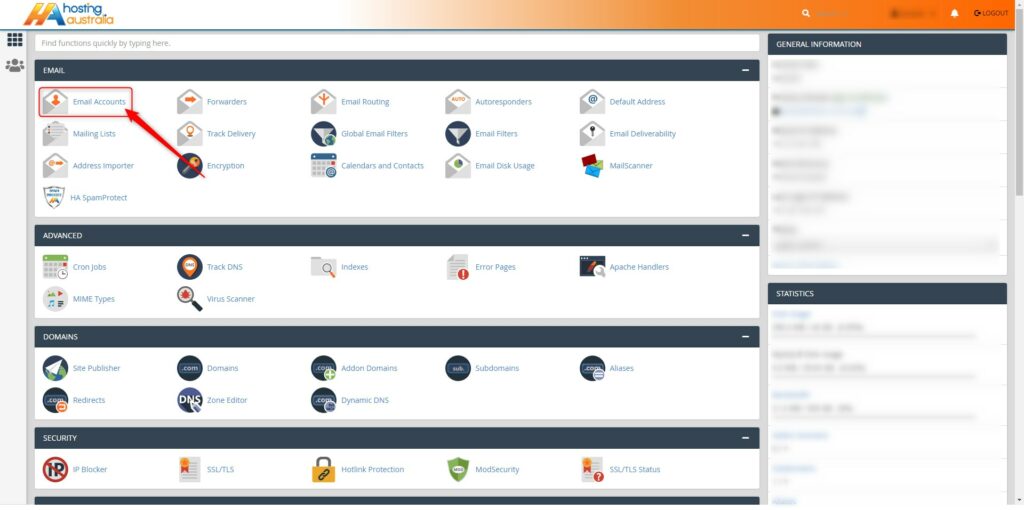
First, you will need to have access to your cPanel. If you are not sure how to access your cPanel, CLICK HERE.
On the cPanel home page. From the main page in cPanel, click the Email Accounts link. this can be found under the Email header.
On the Email Accounts page. Select Create.

Fill out the information and adjust the setting needed.
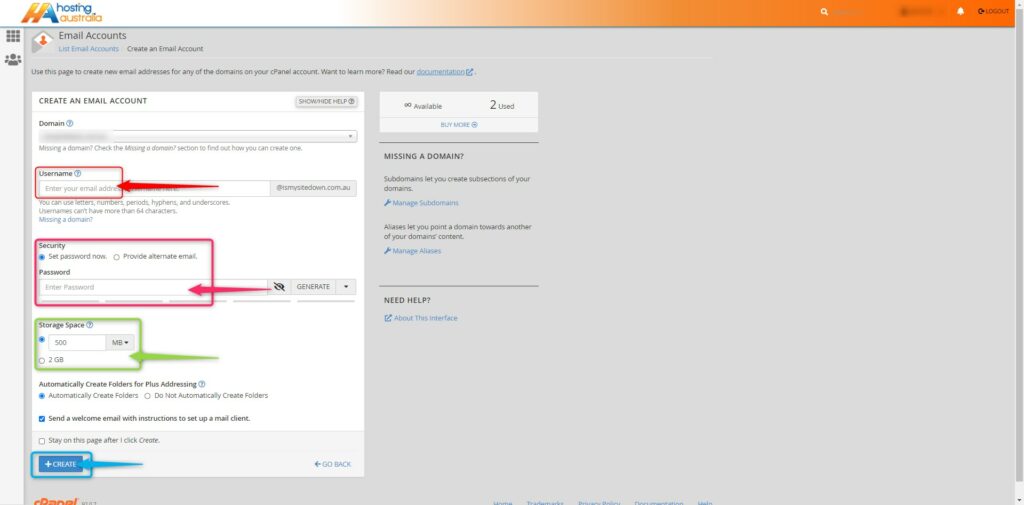
You can create as many new email accounts as your hosting plan allows.
We have also created this helpful how-to video to help assist you in creating an email account.