
Welcome to the world of web hosting! If you're a beginner looking to set up your own website, we understand that the process can seem daunting. But fear not, because this comprehensive guide is here to demystify WordPress hosting and help you get started on the right foot.
Create an image of a beginner's guide to web hosting that is easy to follow and understand, with colorful graphics and simple explanations. Use icons and symbols to represent different aspects of web hosting, such as disk space, bandwidth, security, and performance. Incorporate elements of WordPress into the design, such as the familiar logo or color scheme. Use contrasting colors and bold lines to make the image eye-catching and memorable.
When it comes to web hosting, WordPress is a popular choice due to its user-friendly interface and vast community support. In this guide, we'll walk you through every step of the process, from selecting a hosting provider to designing and managing your website.
Key Takeaways:
Understanding the Basics of Web Hosting
Before you venture into the world of web hosting, it's essential to grasp the basics. Web hosting is the service that allows your website to be accessible on the internet. It involves several steps, from choosing a hosting provider to going live with your website.
To get started with web hosting, you need to select a hosting provider that suits your needs. Consider factors like reliability, customer support, pricing, and features offered. Hosting Australia provides a number of flexible options for hosting
Once you've chosen a hosting provider, you'll need to register a domain. A domain is your website's address on the internet, so choose one that aligns with your brand or website purpose. You can register a domain through a domain registrar or your hosting provider.
After registering your domain, you'll need to set up your hosting account. Provide the necessary details and access your hosting account. This is where you'll design and customize your website. You can use website builders or content management systems like WordPress to create your website with ease.
The Basics of Web Hosting
| Aspect | Description |
| Web Hosting | Service that allows your website to be accessible on the internet. |
| Choosing a Hosting Provider | Selecting a reliable hosting provider based on factors like support, pricing, and features. |
| Registering a Domain | Getting a unique website address through a domain registrar or hosting provider. |
| Setting Up Your Account | Providing necessary details and accessing your hosting account to design and customize your website. |
Understanding the basics of web hosting is crucial for beginners. It sets the foundation for your online presence and ensures a smooth and successful website creation process. With this knowledge, you'll be well-equipped to take the next steps in setting up your website.
Choosing the Right Hosting Provider
When it comes to choosing a web hosting provider as a beginner, there are several factors to consider. Reliability is crucial to ensure that your website stays up and running without any downtime. Look for hosting providers that offer a high uptime guarantee, typically around 99.9%.
Customer support is another important aspect, especially for beginners who may encounter technical difficulties. A hosting provider with 24/7 customer support, preferably through live chat or phone, can provide you with prompt assistance whenever you need it.
Pricing is also a key consideration. As a beginner, you may want to look for affordable hosting options that offer value for money. Compare the pricing plans of different hosting providers and consider any additional features or resources they offer within those plans.
Registering Your Domain
Registering a domain is a crucial step in establishing your online presence. Your domain serves as the unique address for your website on the internet. It is important to choose a domain name that reflects your brand or website purpose. Consider using relevant keywords in your domain to improve search engine visibility. For example, if you are a photography business in Australia, a domain like www.hosting-australia.com could be a suitable choice.
You can register a domain through a domain registrar or your chosen hosting provider. Domain registrars specialize in managing domain registrations and provide a wide range of domain name options. Hosting providers often offer domain registration as part of their services, providing convenience and seamless integration when setting up your website.
When registering your domain, it is essential to consider enabling privacy protection. Privacy protection ensures that your personal contact information, such as your name, address, and phone number, is not publicly accessible in the domain's WHOIS database. This helps protect your privacy and prevent unsolicited contacts or spam.
Setting Up Your Account and Designing Your Website
Once you have chosen a hosting provider, it's time to set up your account and start designing your website. Here are some key steps to guide you through this process:
Step 1: Account Setup
After signing up with your chosen hosting provider, you will need to provide some necessary details to set up your account. This may include your personal information, payment details, and any specific preferences you have for your hosting plan.
Step 2: Accessing Your Hosting Account
Once your account is set up, you will be provided with login credentials to access your hosting account. This will typically involve a username and password combination. Keep these credentials secure and easily accessible for future reference.
Step 3: Designing Your Website
Now comes the exciting part – designing your website. Depending on your technical skills and preferences, you have a few options. One popular choice is using a website builder provided by your hosting provider. Website builders often have user-friendly interfaces and pre-designed templates, making it easier to create a professional-looking website without extensive coding knowledge.
If you prefer more customization and control over your website's design, you can opt for a content management system (CMS) like WordPress. With WordPress, you can choose from a vast selection of themes and plugins to create a unique and functional website that suits your needs.
Remember to pay attention to usability, mobile responsiveness, and aesthetics as you design your website. Make sure it is easy for visitors to navigate and interact with your site across different devices. Additionally, ensure that your website reflects your brand's identity and provides a visually appealing experience for your users.
Table: Key Factors to Consider when Designing Your Website
| Factors | Description |
| Usability | Create an intuitive and user-friendly interface for smooth navigation. |
| Mobile Responsiveness | Ensure your website displays properly on different devices, including smartphones and tablets. |
| Aesthetics | Choose visually appealing colors, fonts, and graphics that align with your brand or website theme. |
| Content Organization | Structure your content in a logical and easily consumable manner for your visitors. |
| SEO Optimization | Implement proper SEO techniques to improve your website's visibility in search engines. |
With your account set up and your website design underway, you are one step closer to launching your online presence. In the next section, we will discuss testing and securing your website to ensure its optimal functionality and protection against potential threats.
Testing and Securing Your Website
Once you have designed your website, it is crucial to thoroughly test its functionality, links, and overall performance. Testing ensures that your website is user-friendly, responsive, and functions properly across different devices and browsers. It is essential to provide your visitors with a seamless browsing experience.
Functional Testing
Functional testing involves checking if all the features and functionalities on your website work as intended. This includes testing forms, buttons, navigation menus, search functionality, and any interactive elements. Make sure that all links are working correctly and lead to the intended pages. Test different scenarios to ensure that your website handles user input accurately.
Performance Testing
Performance testing evaluates the speed and responsiveness of your website. It is important to optimize your website's loading time, as slow-loading pages can lead to a high bounce rate. Use tools like Google PageSpeed Insights or GTmetrix to measure your website's performance and identify areas for improvement. Optimize images, minify code, and leverage browser caching to enhance your website's speed.
Security Testing
Securing your website is of utmost importance to protect it from potential threats and vulnerabilities. Install an SSL certificate to encrypt data transmitted between your website and its visitors, ensuring a secure browsing experience. Regularly update your website's software, plugins, and themes to prevent security breaches. Implement strong passwords, enable two-factor authentication, and use security plugins or firewalls to fortify your website's defenses against malicious attacks.
| Testing Checklist | Description |
| Functional Testing | Check if all features and functionalities are working as intended |
| Link Testing | Ensure all links are functioning properly and lead to the correct pages |
| Performance Testing | Evaluate website speed and optimize loading time |
| Responsive Testing | Test website across various devices and browsers to ensure responsiveness |
| Security Testing | Implement measures to protect your website from security threats and vulnerabilities |
By thoroughly testing your website and implementing robust security measures, you can provide your visitors with a seamless and secure browsing experience. Regularly monitor and update your website to ensure optimal performance and protection against potential risks.
Conclusion
Building and managing a website can be a complex process, but with the right guide, it becomes easier. By understanding the basics of web hosting, choosing the right hosting provider, registering your domain, setting up your account, designing your website, testing and securing it, you can create a successful online presence.
Remember to regularly update and monitor your website's performance for optimal results. This includes checking for any broken links, optimizing your website for speed and mobile responsiveness, and implementing security measures such as SSL certificates, strong passwords, and security plugins or firewalls.
Web hosting plays a crucial role in the success of your website. It determines how fast your website loads, how secure it is, and how easily it can be accessed by your visitors. So, take the time to choose a reliable hosting provider that offers excellent customer support, competitive pricing, and robust features to meet your needs.
Choosing the right hosting plan is crucial for optimizing your WordPress experience. There are different types of hosting plans available, such as shared, VPS, dedicated, and managed WordPress hosting. Each option has its own benefits and considerations that need to be taken into account. It's important to evaluate your website's needs in terms of traffic volume, functionality, and budget to make an informed decision. Managed WordPress hosting can provide additional support and optimization for your site, while shared hosting may be a more affordable option. Consider your specific requirements and choose a hosting plan that best fits your needs.
Key Takeaways:
The Importance of Choosing the Right Hosting Plan
Choosing the right hosting plan is crucial for the success of your website. A reliable hosting provider ensures high uptime, fast server response times, and excellent customer support. It's important to consider factors such as uptime guarantees, server locations, and customer reviews when selecting a hosting provider. Additionally, affordable hosting options are available to meet various budget requirements. Research different WordPress hosting providers to find the one that offers the best combination of reliability, affordability, and support.
When it comes to your website, reliability is key. You want to ensure that your site is always up and running, with minimal downtime. Choosing a hosting provider that offers high uptime guarantees is essential. This means that your website will be accessible to your visitors 24/7, without any interruptions. Additionally, fast server response times are important for a smooth user experience. A hosting provider with servers located close to your target audience can help improve the loading speed of your website.
Customer support is another important factor to consider. You want to choose a hosting provider that has a reputation for excellent customer service. In case you encounter any technical issues or have questions about your hosting plan, you can rely on their support team to assist you. Reading customer reviews can give you insights into the level of support provided by different hosting providers.
| Factors to Consider | Description |
| Uptime guarantees | Ensure your website is accessible to visitors without interruptions |
| Server locations | Choose a hosting provider with servers located close to your target audience for faster loading times |
| Customer reviews | Read reviews to gauge the level of support provided by hosting providers |
Affordability is also a key consideration when choosing a hosting plan. Fortunately, there are hosting providers that offer affordable options without compromising on reliability. It's important to find a balance between cost and quality. Evaluate the features and resources offered by different hosting providers to ensure they meet your website's needs within your budget.
Factors to Consider When Choosing a Hosting Plan
When selecting a hosting plan for your WordPress site, there are several important factors that you need to consider. These factors will help ensure that you choose a hosting plan that meets your specific needs and delivers the performance and reliability you require. Take the time to evaluate the following:
By carefully considering these factors, you can make an informed decision when choosing a hosting plan that suits your specific needs.
Table: Key Factors to Consider When Choosing a Hosting Plan
| Factors | Considerations |
| Traffic volume and functionality | Assess expected traffic volume and functionality requirements to determine necessary resources and scalability. |
| Support and customer service | Ensure hosting provider offers responsive and helpful support channels. |
| Features and resources | Research and compare hosting packages to find ones that offer required features and resources. |
| Price and budget | Determine budget and compare pricing of different hosting plans. |
Optimizing Your WordPress Site for Better Performance
To optimize your WordPress site for better performance, there are several strategies that you can implement. Start by choosing a hosting plan that provides the necessary resources for your site's needs. Keep your WordPress site updated by regularly applying updates to WordPress core, themes, and plugins. This ensures that your site is running efficiently and securely.
Additionally, optimize your images by compressing and resizing them before uploading to your site. Use a content delivery network (CDN) to improve website loading times by serving content from servers located closer to your visitors. Minimize HTTP requests by reducing the number of resources requested by the browser. Use caching to store frequently accessed data and improve website speed. Finally, optimize your database by cleaning up unused tables and optimizing queries. These strategies combined will help improve the performance of your WordPress site.
| Optimization Strategy | Description |
| Choose the right hosting plan | Ensure your hosting plan provides adequate resources for your site's needs |
| Keep your site updated | Regularly apply updates to WordPress core, themes, and plugins |
| Optimize images | Compress and resize images before uploading to your site |
| Use a content delivery network (CDN) | Serve content from servers closer to your visitors to improve loading times |
| Minimize HTTP requests | Reduce the number of resources requested by the browser |
| Use caching | Store frequently accessed data to improve website speed |
| Optimize your database | Clean up unused tables and optimize queries |
By following these optimization strategies, you can ensure that your WordPress site performs at its best, providing a fast and seamless experience for your visitors.
A bird's eye view of a lineup of small, colorful boxes labeled with different budget-friendly WordPress hosting plans. Each box is equal in size and arranged in a neat row on a white background. The boxes vary in color and have minimal design elements, such as basic icons representing key features of each plan. The overall tone is professional and minimalist, emphasizing affordable options for users looking for reliable hosting solutions for their WordPress site.
The Role of a Lightweight WordPress Theme
When it comes to optimizing your WordPress site for performance, choosing a lightweight theme plays a crucial role. A lightweight theme is designed to prioritize speed and efficiency, reducing the size of CSS and JavaScript files and minimizing server requests. This has a direct impact on your website's loading speed and overall user experience.
By selecting a lightweight WordPress theme, you can greatly improve website speed and ensure a smooth browsing experience for your visitors. These themes are optimized to prioritize the essential features and functionalities, avoiding unnecessary bloat that can slow down your site.
There are several popular lightweight WordPress themes available, such as Astra, GeneratePress, and Schema. These themes offer a balance between design flexibility and performance optimization. When choosing a lightweight theme, consider the specific design and functionality requirements of your site, and select one that best aligns with your needs.
Benefits of Lightweight Themes:
| Benefits | Description |
| Improved Loading Speed | Lightweight themes prioritize speed, resulting in faster loading times. |
| Enhanced User Experience | Faster loading speeds provide a smoother browsing experience for visitors. |
| Efficient Resource Utilization | Lightweight themes use minimal resources, reducing strain on servers. |
| Better SEO Performance | Fast-loading websites tend to rank higher in search engine results. |
| Compatibility with Plugins | Lightweight themes often work seamlessly with various WordPress plugins. |
By choosing a lightweight WordPress theme, you can significantly improve the performance and speed of your site. Consider the benefits and choose a theme that aligns with your overall website goals and objectives.
Monitoring Your Website's Performance
Monitoring your website's performance is crucial for maintaining optimal speed and user experience. By regularly analyzing your site's performance, you can identify any issues that may be impacting its speed and take proactive measures to address them. There are various tools available that can help you monitor your website's performance and provide valuable insights on how to improve it.
One such tool is Google PageSpeed Insights, which analyzes your site's loading speed and provides suggestions for improvement. GTmetrix is another popular tool that offers detailed reports on your site's performance, including load time, page size, and the number of requests. Additionally, Pingdom can help you monitor your site's uptime, alerting you if there are any issues.
Regularly monitoring your website's performance allows you to identify and fix any performance issues before they impact your visitors' experience. By taking proactive measures to optimize your site's speed and responsiveness, you can ensure that your WordPress site delivers the best user experience possible.
Table: Website Performance Monitoring Tools
| Tool | Description | Key Features |
| Google PageSpeed Insights | A tool provided by Google that analyzes your site's performance and provides suggestions for improvement. | - Analyzes website speed and performance - Provides actionable insights and recommendations - Measures mobile and desktop performance |
| GTmetrix | A tool that provides detailed reports on your site's performance, including load time, page size, and requests. | - Measures website performance metrics - Offers insights and recommendations for improvement - Provides historical performance data |
| Pingdom | A tool that monitors your site's uptime and alerts you if there are any issues. | - Monitors website uptime and performance - Sends alerts in case of downtime or performance degradation - Provides detailed performance reports |
Using these tools, you can gain valuable insights into your website's performance and take the necessary steps to optimize it. Regular monitoring allows you to track your site's speed, uptime, and overall performance, ensuring that your visitors have a seamless browsing experience. By addressing any issues promptly, you can maintain optimal speed and user satisfaction on your WordPress site.
Choosing a Reliable Hosting Provider
When it comes to your WordPress site, choosing a reliable hosting provider is crucial for ensuring its performance and security. A reliable hosting provider offers high uptime, fast server response times, and excellent customer support. But with so many options available, how do you choose the right one?
Firstly, consider the uptime guarantees provided by the hosting provider. Uptime refers to the percentage of time that your website will be up and running. Look for providers that offer a minimum uptime guarantee of 99.9% to ensure that your site is always accessible to visitors.
Secondly, take into account the server locations offered by the hosting provider. The closer the server is to your target audience, the faster your website will load for them. This will help improve user experience and overall site performance.
Lastly, take the time to read customer reviews and testimonials to get an idea of the level of customer support provided by the hosting provider. A responsive and helpful support team can make a big difference if you encounter any issues with your WordPress site.
By choosing a reliable hosting provider that offers high uptime, fast server response times, and excellent customer support, you can ensure that your WordPress site remains secure and performs optimally for your visitors.
Conclusion
In conclusion, choosing the right hosting plan is vital for optimizing your WordPress experience. Consider factors such as traffic volume, functionality, and budget when selecting a plan. Research different hosting providers to find one that offers reliable and affordable options with excellent customer support.
Implement optimization strategies such as keeping your site updated, optimizing images, and using a content delivery network. Minimize HTTP requests, leverage caching, and optimize your database to improve website speed. Additionally, selecting a lightweight WordPress theme can greatly enhance your site's performance.
Regularly monitor your website's performance using tools like Google PageSpeed Insights, GTmetrix, and Pingdom. This allows you to identify and address any performance issues promptly, ensuring your site remains fast and responsive.
Choose a reliable hosting provider that can offer high uptime, fast server response times, and exceptional customer support for your WordPress site. By following these steps, you can optimize your WordPress site for speed, security, and overall performance.
WordPress is a popular open-source website builder and content management system that powers more than 43% of all websites on the internet. Understanding how WordPress works behind the scenes is crucial for optimizing performance, security, and customization. In this comprehensive guide, we will explore the technical aspects of WordPress web hosting, including the evolution of WordPress, its open-source nature, and the key files and folders that drive the platform's functionality.
A visually striking representation of the technical aspects of WordPress hosting, featuring complex server infrastructure and advanced software integrations. Show the system in action, with a focus on speed and reliability. Use vibrant colors to convey the power and efficiency of this cutting-edge technology.
Key Takeaways:
The WordPress File and Folder Structure
The core of a WordPress site consists of files and folders that work together to power the platform. Understanding the file and folder structure of WordPress is crucial for troubleshooting and making informed decisions about your site.
The WordPress root directory contains essential files and folders such as wp-admin, wp-content, and wp-includes. The wp-admin folder manages the administrative interface of WordPress, while the wp-includes folder houses the core software. It is important to note that modifying core files can lead to site instability, so it is advised to avoid making changes to these files.
The functions.php file can be modified to add custom code and enhance site functionality. The wp-config.php file is responsible for storing database connection information and other configuration settings. Understanding the role of these files and folders is essential for maintaining a stable and secure WordPress site.
The WordPress File and Folder Structure
In order to understand the technical aspects of WordPress web hosting, you must first familiarize yourself with the file and folder structure that powers the platform. The WordPress root directory contains several crucial files and folders that work together to ensure the smooth functioning of your website.
| Folder | Description |
| wp-admin | Manages the administrative interface of WordPress |
| wp-content | Stores themes, plugins, and uploaded media |
| wp-includes | Houses the core software of WordPress |
These folders play a crucial role in the functioning of WordPress, and it's important to note that modifying core files can lead to site instability. However, you can enhance your site's functionality by modifying the functions.php file, which allows you to add custom code. The wp-config.php file, on the other hand, stores database connection information and other configuration settings.
By understanding the file and folder structure of WordPress, you'll be able to troubleshoot issues more effectively and make informed decisions about your site's customization and optimization.
WordPress Hooks and Actions
WordPress hooks and actions play a crucial role in customizing the functionality of your WordPress site. Hooks allow you to insert custom code at specific points during the WordPress runtime. They provide a way to modify or extend the default behavior of WordPress without modifying the core files.
Actions, on the other hand, enable you to add or modify data without returning any further information. They are typically used to perform tasks, such as saving data to the database or sending an email, after a specific event or trigger occurs.
By utilizing hooks and actions, you can customize the behavior of your WordPress site according to your specific needs. This includes adding new features, modifying existing functionality, and integrating with other systems. It is a powerful tool for code customization, plugin development, and creating a tailored web experience.
The Difference Between Hooks and Actions
Understanding the difference between hooks and actions is essential for effectively customizing your WordPress site. Hooks, also known as filters, allow you to modify or override existing data or functionality. They can be used to alter the output of a function or add additional parameters to a function call.
Actions, on the other hand, are triggers that allow you to perform additional tasks at specific points in the WordPress runtime. They are typically used to perform actions that don't require any data to be returned, such as sending a notification or updating a database.
| Hook | Action |
| Allows you to modify existing data or functionality | Allows you to perform additional tasks without returning any data |
| Used to alter the output of a function or add parameters to a function call | Used to perform actions that don't require data to be returned |
| Example: 'the_content' filter | Example: 'wp_login' action |
Understanding how hooks and actions work and when to use them is essential for customizing your WordPress site effectively. By harnessing their power, you can unlock the full potential of WordPress and create a unique web experience tailored to your needs.
WordPress Core Files and Database
Understanding the core files and database of WordPress is crucial for managing site functionality and content. The core files serve as the foundation of every WordPress site, while the database stores all site content, including posts, pages, user data, and plugin settings. Let's take a closer look at these key components:
WordPress Core Files
The WordPress core files are responsible for managing the overall functionality of your website. These files include the index.php file, which loads pages and initializes the core files when a request is made, and the wp-config.php file, which contains crucial configuration settings and database connection information. It's important to note that modifying core files can lead to site instability, so it's recommended to avoid making changes to these files unless you are an experienced developer.
WordPress Database
The WordPress database is where all your site content is stored. It includes information such as posts, pages, comments, users, and settings. The database is essential for managing and organizing your site's content. Whenever you create a new post or page, update a plugin setting, or change a user's information, the changes are stored in the database. Understanding how the database works can help you troubleshoot issues related to content, such as missing posts or incorrect settings.
Managing the Core Files and Database
Proper management of the core files and database is vital for the smooth operation of your WordPress site. It's essential to keep your core files up to date by regularly updating WordPress to the latest version. Additionally, performing regular backups of your database helps ensure that you can easily restore your site in case of any issues or data loss. If you're not comfortable managing the core files and database yourself, consider using a managed WordPress hosting service that takes care of these technical aspects for you.
| Core Files | Database |
| index.php | Posts |
| wp-config.php | Pages |
| Comments | |
| Users | |
| Settings |
By understanding the core files and database of WordPress, you'll be able to effectively manage your site's functionality and content. Remember to handle core files with caution and regularly backup your database to ensure a smooth and secure website.
WordPress Web Hosting and Performance Optimization
When it comes to WordPress web hosting, finding the best provider is essential for optimal performance, security, and reliability. A fast and secure hosting environment can significantly enhance your website's speed, user experience, and search engine rankings. Here are some key factors to consider when selecting a WordPress hosting provider:
Managed WordPress hosting services are specifically tailored for WordPress sites and often provide additional performance optimizations. These can include server-level caching, content delivery networks (CDNs), and automatic updates, further enhancing the speed and reliability of your website.
By understanding the various options and factors involved in WordPress web hosting, you can make an informed decision and ensure the best possible performance for your site. Whether you prioritize speed, security, or affordability, finding a reliable hosting provider that meets your specific needs is crucial for the success of your WordPress website.
Conclusion
Understanding the technical side of WordPress web hosting is crucial for maximizing the performance, security, and customization of your website. By familiarizing yourself with the WordPress file and folder structure, hooks and actions, core files and database, and the various options for WordPress web hosting, you can make informed decisions and optimize your site for success.
Whether you are looking for affordable WordPress hosting or seeking the top WordPress hosting providers, finding a reliable hosting service is essential for ensuring a fast, secure, and efficient website. Take into consideration your specific needs, budget, and performance requirements when selecting a hosting provider.
With the right technical foundation, you can unleash the full potential of WordPress and create a powerful online presence. Invest in affordable WordPress hosting and choose a top hosting provider to achieve the best results for your website.
Having a fast and reliable hosting solution is crucial for your WordPress site. Slow loading times can lead to poor user experience, decreased search engine rankings, and lower conversion rates. In this section, we'll discuss why website speed is important and how to choose a hosting provider that offers optimal performance.
A speedometer with a WordPress logo in the center, surrounded by a circle of server towers.
Key Takeaways:
By following these strategies, you can select a fast and reliable hosting solution, optimize your WordPress hosting speed, and significantly improve your website's performance.
The Importance of Website Speed
When it comes to your website, speed matters. Website speed optimization is not just about ensuring fast loading times; it is also about delivering a seamless user experience. Fast-loading websites contribute to higher user engagement, lower bounce rates, and improved search engine rankings.
Users today have little patience for slow websites. Research shows that 53% of users will abandon a website if it takes more than three seconds to load. This not only leads to a poor user experience but also negatively impacts your website's conversion rates. On the other hand, a fast website creates a positive impression, encourages users to stay longer, and increases the chances of them converting into customers.
But it's not just users who appreciate fast websites. Search engines like Google prioritize websites with fast loading times, considering it an important factor in their ranking algorithms. By optimizing your website's speed, you not only enhance the user experience but also boost its visibility in search engine results, leading to increased organic traffic and potential customers.
Benefits of Fast Loading Websites:
Factors Affecting Website Speed:
Several factors can impact the speed of your website. Unoptimized images, too many plugins, outdated plugins, inefficient code, and embedded external media can slow down page loading times. It is crucial to address these factors to ensure your website delivers the best experience to your users and performs well in search engine rankings.
Continued in Section 3...
Factors that Affect WordPress Site Speed
When it comes to the speed of your WordPress site, there are several factors that can have an impact. By understanding these factors, you can take the necessary steps to optimize your site's performance and ensure a fast and seamless user experience.
Unoptimized Images
One common culprit of slow page loading times is unoptimized images. Large image file sizes can significantly slow down your website. To resolve this issue, make sure to optimize your images by compressing them without compromising their quality. There are various plugins and online tools available that can help you easily optimize your images for the web.
Too Many Plugins
While plugins can offer valuable functionality to your WordPress site, having too many can negatively impact its speed. Each plugin you install adds additional code that needs to be processed, potentially slowing down your site. It's essential to carefully consider the plugins you truly need and regularly review and delete any outdated or unused plugins.
Outdated Plugins and Inefficient Code
Outdated plugins and inefficiently coded themes or customizations can also contribute to slower page loading times. Developers regularly release updates to plugins and themes to improve performance and security. By keeping your plugins, themes, and WordPress version up to date, you can ensure that your site is running smoothly and efficiently.
External Embedded Media
Embedding external media, such as videos or social media content, can add to your page loading time. This is because each external element requires additional server requests to load the content, which can slow down your site. Consider hosting videos on external platforms and try to limit the amount of external content you embed on your pages to optimize site speed.
By addressing these factors, you can significantly improve the speed of your WordPress site and enhance the overall user experience. Remember to regularly monitor your site's performance and make adjustments as needed to ensure optimal speed and functionality.
Tips for Improving WordPress Hosting Speed
If you want to enhance the speed of your WordPress hosting, there are several key steps you can take. By following these tips, you can ensure that your site performs optimally and provides a fast and efficient user experience.
Choose a Reliable Hosting Provider
One of the most crucial factors for improving WordPress hosting speed is to select a reliable hosting provider. Look for a provider that offers high-performance servers and has a track record of delivering fast and stable hosting services. A reliable hosting provider will ensure that your website is consistently available and loading quickly for your visitors.
Update Plugins and Themes Regularly
Keeping your plugins and themes up to date is essential for improving site speed. Outdated plugins and themes can have performance issues and may not be compatible with the latest version of WordPress. By updating them regularly, you can ensure that you have access to the latest optimizations and bug fixes, which can positively impact your website's speed.
Use the Latest Version of PHP
Using the latest version of PHP is another effective way to improve your WordPress hosting speed. PHP is the scripting language that powers WordPress, and newer versions often include performance enhancements and optimizations. Upgrading to the latest version of PHP can significantly boost your site's speed and overall performance.
Delete Unused Plugins
Having unused plugins on your WordPress site can impact its speed and performance. These plugins can add unnecessary code and database queries, leading to slower loading times. By regularly reviewing and deleting unused plugins, you can streamline your site and improve its speed.
Install High-Quality Plugins and Use a Lightweight Theme
When selecting plugins for your WordPress site, opt for high-quality options that are known for their performance and optimization. These plugins are typically designed to be efficient and lightweight, minimizing their impact on your site's speed. Additionally, using a lightweight theme can also contribute to faster loading times, as it requires fewer server resources to render the page.
By following these tips, you can significantly improve the speed and performance of your WordPress hosting. Remember to regularly monitor your site's speed and make necessary optimizations to ensure that your visitors have a fast and seamless browsing experience.
| Tip | Description |
| Choose a Reliable Hosting Provider | Select a hosting provider that offers high-performance servers and a proven track record of reliability. |
| Update Plugins and Themes Regularly | Keep your plugins and themes up to date to access the latest optimizations and bug fixes. |
| Use the Latest Version of PHP | Upgrade to the latest version of PHP to take advantage of performance enhancements. |
| Delete Unused Plugins | Regularly review and delete unused plugins to streamline your site and reduce unnecessary code. |
| Install High-Quality Plugins and Use a Lightweight Theme | Choose optimized plugins and a lightweight theme to minimize the impact on your site's speed. |
These tips will help you optimize your WordPress hosting speed and provide a fast and efficient experience for your website visitors.
Optimizing Website Content for Speed
Optimizing the content on your website is a crucial step in improving its speed and performance. By implementing the following strategies, you can ensure your site loads quickly and efficiently.
Images are an essential part of any website, but large file sizes can significantly slow down loading times. To optimize your images:
By reducing image file sizes, you can improve page loading times and enhance the overall user experience.
Lazy loading is a technique where content (such as images, videos, or iframes) is loaded only when needed. This improves initial page load times and reduces the amount of data that needs to be transferred. To implement lazy loading:
By implementing lazy loading, your website will load faster and provide a smoother user experience.
Hosting videos directly on your server can consume a significant amount of resources and slow down your website. Instead, consider using external video hosting platforms like YouTube or Vimeo. These platforms are designed to handle video streaming efficiently and will not affect your site's performance.
CSS and JavaScript files can contribute to slow loading times if they are large and not optimized. Reduce file sizes by:
By reducing the sizes of your CSS and JavaScript files, you can improve your website's speed and performance.
Additional Techniques for Speeding Up WordPress
When it comes to optimizing your WordPress site for speed, there are several additional techniques you can implement to further improve its performance. These techniques will help ensure that your site loads quickly and efficiently, providing a seamless user experience. Let's take a look at some of these techniques:
A caching plugin is a powerful tool that can significantly improve your site's speed. It works by storing static content, such as images and CSS files, and serving them directly to visitors instead of generating them from scratch every time. This reduces server load and speeds up page loading times. There are several caching plugins available for WordPress, such as W3 Total Cache and WP Super Cache, that are easy to install and configure.
Complex page designs and content with excessive elements can slow down your site. To improve speed, consider simplifying your page designs by minimizing the number of images, videos, and other media elements. Optimize your content by removing unnecessary plugins, widgets, and scripts. By reducing the amount of data that needs to be loaded, you can significantly improve your site's speed.
Regularly cleaning up your WordPress database can help improve your site's performance. Over time, your database can accumulate unnecessary data, such as post revisions, spam comments, and unused plugin tables. By deleting this unnecessary data, you can optimize your database and improve the speed of your site. You can use plugins like WP-Optimize or WP-Sweep to easily clean up your database.
Every time you save a post or page, WordPress creates a new revision, which can result in a bloated database. By limiting the number of post revisions, you can reduce the size of your database and improve your site's speed. Additionally, avoid excessive redirects as they can slow down page loading times. Keep your redirects to a minimum and ensure that they are necessary.
A Content Delivery Network (CDN) is a network of servers located in different parts of the world that store copies of your site's content. When a user accesses your site, the CDN serves the content from the server closest to them, reducing the distance the data needs to travel and improving load times. Popular CDN services include Cloudflare, StackPath, and Amazon CloudFront.
GZIP compression is a method that reduces the size of your website's files, such as CSS and JavaScript, before they are sent to the user's browser. This compression technique significantly reduces file sizes, resulting in faster loading times. Most modern web servers and browsers support GZIP compression, and enabling it is as simple as adding a few lines of code to your server's configuration file.
External scripts, such as those used for analytics or advertising, can slow down your site if they take too long to load. Evaluate the necessity of each external script and consider removing or replacing them with lightweight alternatives. Additionally, avoid hotlinking, which is the practice of embedding images or other media from external websites on your own site. Hotlinking can negatively impact your site's loading speed, so it's best to host the media files on your own server.
Scheduling resource-intensive tasks, such as database backups or plugin updates, during low-traffic periods can help minimize their impact on your site's speed. By avoiding peak times, you can ensure that your site remains fast and responsive even during maintenance or updates.
If you have long posts or a large number of comments on your site, consider splitting them into multiple pages. This can improve loading times by loading only a portion of the content at a time. Many WordPress themes and plugins offer pagination options that make it easy to split long posts and paginate comments, providing a better user experience.
| Technique | Benefits |
| Install a caching plugin | Reduces server load and speeds up page loading times |
| Simplify page designs and content | Minimizes the amount of data that needs to be loaded |
| Tidy up your WordPress database | Optimizes the database and improves site speed |
| Limit post revisions and avoid redirects | Reduces the size of the database and improves loading times |
| Use a Content Delivery Network (CDN) | Improves load times by serving content from servers closest to users |
| Compress files with GZIP | Significantly reduces file sizes and improves loading times |
| Limit external scripts and avoid hotlinking | Reduces the impact of external scripts and avoids slowing down the site |
| Schedule tasks for low-traffic periods | Minimizes the impact of resource-intensive tasks on site speed |
| Split long posts and paginate posts and comments | Improves loading times by loading content in smaller portions |
Conclusion
Optimizing the speed of your WordPress site is crucial for providing a fast and reliable hosting solution and improving website performance. By following the steps and techniques mentioned in this article, you can significantly enhance your WordPress hosting speed and ensure an optimal user experience.
Remember to choose a hosting provider that prioritizes speed and reliability to lay a strong foundation for your website. Regularly update your plugins and themes, use the latest version of PHP, and delete unused plugins to eliminate any unnecessary load on your site. Install high-quality, performance-optimized plugins and opt for lightweight themes to further improve loading times.
Additionally, optimizing your website content by compressing and optimizing images, implementing lazy loading for content, and avoiding hosting videos on your server can further boost site speed. Minify CSS and JavaScript files to reduce their size and limit external scripts and hotlinking to reduce unnecessary requests. Consider implementing a caching plugin, tidying up your WordPress database, scheduling tasks for low-traffic periods, and paginating long posts and comments to optimize performance.
Continuously monitor and test your site's speed to ensure it maintains its fast loading times. By optimizing your WordPress hosting speed and improving website performance, you will provide a seamless user experience and enhance your site's visibility and usability.
WordPress security is a critical concern for all website owners. With thousands of websites being blacklisted every day for malware and phishing, it's essential to implement the best practices for securing your WordPress blog. This guide will provide you with actionable steps and insights into WordPress security, including the importance of keeping WordPress updated, using strong passwords, and the role of web hosting in protecting your site.
Key Takeaways
Why WordPress Security is Important
The security of your WordPress site is of utmost importance in order to protect your website from hackers and prevent malware attacks. Security breaches can lead to data theft, the distribution of harmful malware, and even ransomware attacks. Not only can these breaches cause significant damage to your website and reputation, but they can also result in legal and financial consequences for your business.
In addition to protecting your own information, it is essential to consider your visitors' expectations. Internet users today are increasingly aware of the importance of online security, and they expect websites to provide a safe browsing experience. A secure website builds trust and credibility with your audience, increasing the likelihood of return visits and conversions. Furthermore, search engines like Google prioritize secure sites in their rankings, meaning that investing in WordPress security measures can also improve your website's visibility and organic traffic.
Protect Your Website from Hackers and Malware
By implementing proper WordPress security measures, you can safeguard your website and protect it from potential threats. This includes regularly updating WordPress, plugins, and themes, as updates often include security patches that address vulnerabilities. It also involves using strong passwords for your admin accounts, limiting login attempts, and enabling two-factor authentication to prevent unauthorized access.
Another key aspect of WordPress security is choosing a reliable web hosting provider. A secure hosting environment ensures that your website is hosted on servers that are protected against common threats and regularly updated with the latest security measures. Managed WordPress hosting, in particular, offers enhanced security features such as automatic backups, regular software updates, and advanced security configurations, providing an additional layer of protection for your site.
| Benefits of WordPress Security | Measures to Protect Your Website |
| 1. Protection against data theft and malware distribution | 1. Regularly update WordPress, plugins, and themes |
| 2. Enhanced trust and credibility with your audience | 2. Use strong passwords and limit login attempts |
| 3. Improved search engine visibility and organic traffic | 3. Enable two-factor authentication |
| 4. Legal and financial consequences | 4. Choose a reliable web hosting provider |
Keeping WordPress Updated
Regularly updating your WordPress installation, plugins, and themes is essential for maintaining a secure website. Updates often include security patches that address vulnerabilities and protect against potential threats. By keeping your WordPress site up to date, you minimize the risk of hacking attempts and ensure the stability of your site.
Updating WordPress is a straightforward process. Once a new version is released, you'll receive a notification in your WordPress dashboard. Simply click on the update button to initiate the update. It's important to back up your site before performing any updates to avoid any potential data loss. Additionally, it's crucial to update your plugins and themes as well. Outdated versions can expose your site to security risks.
To update your plugins, go to the "Plugins" section in your WordPress dashboard. If an update is available, you'll see a notification next to the plugin name. Click on the "Update Now" button to update the plugin. Similarly, for themes, navigate to the "Appearance" section and click on the "Themes" tab. If an update is available for your active theme, you'll see an update notification. Click on the "Update Now" button to update the theme.
| Key Actions | Purpose |
| Regularly update WordPress, plugins, and themes | Address vulnerabilities and protect against potential threats |
| Back up your site before performing updates | Minimize the risk of data loss |
| Update plugins in the "Plugins" section | Ensure plugins are up to date |
| Update themes in the "Appearance" section | Keep your active theme secure |
By prioritizing regular updates, you can strengthen the security of your WordPress site and stay protected against emerging threats.
Passwords and User Permissions
Creating strong passwords and managing user permissions are vital aspects of WordPress security. By implementing best practices in password management and user access control, you can significantly enhance the security of your WordPress site and protect it from unauthorized access.
Strong Passwords
Using strong, unique passwords is essential to prevent unauthorized access to your WordPress site. Avoid using commonly used passwords or personal information that can be easily guessed. Instead, create passwords with a combination of uppercase and lowercase letters, numbers, and special characters. Regularly updating passwords is also recommended to mitigate any potential risks.
Limit Login Attempts
Limiting the number of login attempts can deter hackers from using brute force attacks to gain access to your WordPress site. By setting a limit on the number of failed login attempts, you can effectively block repeated login attempts, making it more difficult for unauthorized users to guess or crack your password.
Two-Factor Authentication
Implementing two-factor authentication adds an extra layer of security to your WordPress login process. This authentication method requires users to provide an additional verification code, usually sent to their mobile device, after entering their password. By enabling two-factor authentication, you can ensure that only authorized individuals with both the password and the verification code can access your WordPress site.
Password Protect wp-admin and Login Pages
Another important security measure is to password protect the wp-admin directory and the login pages of your WordPress site. This additional layer of protection prevents unauthorized access to sensitive areas of your site, such as the WordPress admin panel. Password protecting these pages adds an extra barrier for potential hackers, making it more challenging for them to gain control of your WordPress site.
Table: User Permissions
| User Role | Capabilities |
| Administrator | Full access to all WordPress settings and functionality |
| Editor | Can create, edit, publish, and delete all posts and pages |
| Author | Can create, edit, publish, and delete their own posts |
| Contributor | Can write and edit their own drafts, but cannot publish them |
| Subscriber | Can only manage their profile and leave comments on your site |
Understanding user roles and permissions is crucial for controlling access to your WordPress site. By assigning appropriate user roles to individuals, you can limit their capabilities and ensure that only trusted users have access to critical administrative functions. Regularly review and update user permissions to maintain the security of your WordPress site.
The Role of Web Hosting
When it comes to securing your WordPress site, the choice of web hosting provider is crucial. A reliable and secure web hosting provider plays a significant role in protecting your website from potential threats. With web hosting security being a top priority, it's essential to choose a provider that offers advanced security features and robust infrastructure.
Managed WordPress hosting is an excellent option for ensuring the security of your WordPress site. By opting for managed hosting, you can benefit from automatic backups, regular updates, and enhanced security configurations. These features can significantly reduce the risk of security breaches and provide peace of mind.
The Benefits of Managed WordPress Hosting
Managed WordPress hosting offers several advantages when it comes to website security:
By choosing a secure web hosting provider, such as a reputable managed WordPress hosting service, you can enhance the security of your WordPress site and protect it from potential threats.
Conclusion
Securing your WordPress blog with hosting is of utmost importance to protect your website from hackers and malware. By implementing the best practices outlined in this guide, you can significantly enhance the security of your WordPress site and ensure a safe online presence.
Remember that WordPress security is an ongoing process, and it requires active vigilance. Keep your WordPress installation, plugins, and themes up to date to stay protected against potential threats. Additionally, use strong and unique passwords for your admin, FTP, and hosting accounts. Consider implementing measures like limiting login attempts and enabling two-factor authentication to further enhance your site's security.
Choosing a secure web hosting provider is also crucial. Opt for a reputable company that takes proactive measures to protect their servers and offers advanced security configurations. Managed WordPress hosting can provide automatic backups, regular updates, and enhanced security features to ensure the safety of your website. Prioritize the security of your WordPress site by selecting a web hosting provider with a proven track record in WordPress security.
By following these WordPress security best practices and investing in secure WordPress hosting, you can protect your website from hackers, safeguard your data, and maintain the trust of your visitors. Don't compromise on the importance of WordPress security - prioritize the security of your WordPress blog today for a secure and successful online presence.
Create an image featuring a shield or barrier with a WordPress logo inside, representing the idea of secure hosting.
Key Takeaways
Why WordPress Security is Important
The security of your WordPress site is of utmost importance in order to protect your website from hackers and prevent malware attacks. Security breaches can lead to data theft, the distribution of harmful malware, and even ransomware attacks. Not only can these breaches cause significant damage to your website and reputation, but they can also result in legal and financial consequences for your business.
In addition to protecting your own information, it is essential to consider your visitors' expectations. Internet users today are increasingly aware of the importance of online security, and they expect websites to provide a safe browsing experience. A secure website builds trust and credibility with your audience, increasing the likelihood of return visits and conversions. Furthermore, search engines like Google prioritize secure sites in their rankings, meaning that investing in WordPress security measures can also improve your website's visibility and organic traffic.
Protect Your Website from Hackers and Malware
By implementing proper WordPress security measures, you can safeguard your website and protect it from potential threats. This includes regularly updating WordPress, plugins, and themes, as updates often include security patches that address vulnerabilities. It also involves using strong passwords for your admin accounts, limiting login attempts, and enabling two-factor authentication to prevent unauthorized access.
Another key aspect of WordPress security is choosing a reliable web hosting provider. A secure hosting environment ensures that your website is hosted on servers that are protected against common threats and regularly updated with the latest security measures. Managed WordPress hosting, in particular, offers enhanced security features such as automatic backups, regular software updates, and advanced security configurations, providing an additional layer of protection for your site.
| Benefits of WordPress Security | Measures to Protect Your Website |
| 1. Protection against data theft and malware distribution | 1. Regularly update WordPress, plugins, and themes |
| 2. Enhanced trust and credibility with your audience | 2. Use strong passwords and limit login attempts |
| 3. Improved search engine visibility and organic traffic | 3. Enable two-factor authentication |
| 4. Legal and financial consequences | 4. Choose a reliable web hosting provider |
Keeping WordPress Updated
Regularly updating your WordPress installation, plugins, and themes is essential for maintaining a secure website. Updates often include security patches that address vulnerabilities and protect against potential threats. By keeping your WordPress site up to date, you minimize the risk of hacking attempts and ensure the stability of your site.
Updating WordPress is a straightforward process. Once a new version is released, you'll receive a notification in your WordPress dashboard. Simply click on the update button to initiate the update. It's important to back up your site before performing any updates to avoid any potential data loss. Additionally, it's crucial to update your plugins and themes as well. Outdated versions can expose your site to security risks.
To update your plugins, go to the "Plugins" section in your WordPress dashboard. If an update is available, you'll see a notification next to the plugin name. Click on the "Update Now" button to update the plugin. Similarly, for themes, navigate to the "Appearance" section and click on the "Themes" tab. If an update is available for your active theme, you'll see an update notification. Click on the "Update Now" button to update the theme.
| Key Actions | Purpose |
| Regularly update WordPress, plugins, and themes | Address vulnerabilities and protect against potential threats |
| Back up your site before performing updates | Minimize the risk of data loss |
| Update plugins in the "Plugins" section | Ensure plugins are up to date |
| Update themes in the "Appearance" section | Keep your active theme secure |
By prioritizing regular updates, you can strengthen the security of your WordPress site and stay protected against emerging threats.
Passwords and User Permissions
Creating strong passwords and managing user permissions are vital aspects of WordPress security. By implementing best practices in password management and user access control, you can significantly enhance the security of your WordPress site and protect it from unauthorized access.
Strong Passwords
Using strong, unique passwords is essential to prevent unauthorized access to your WordPress site. Avoid using commonly used passwords or personal information that can be easily guessed. Instead, create passwords with a combination of uppercase and lowercase letters, numbers, and special characters. Regularly updating passwords is also recommended to mitigate any potential risks.
Limit Login Attempts
Limiting the number of login attempts can deter hackers from using brute force attacks to gain access to your WordPress site. By setting a limit on the number of failed login attempts, you can effectively block repeated login attempts, making it more difficult for unauthorized users to guess or crack your password.
Two-Factor Authentication
Implementing two-factor authentication adds an extra layer of security to your WordPress login process. This authentication method requires users to provide an additional verification code, usually sent to their mobile device, after entering their password. By enabling two-factor authentication, you can ensure that only authorized individuals with both the password and the verification code can access your WordPress site.
Password Protect wp-admin and Login Pages
Another important security measure is to password protect the wp-admin directory and the login pages of your WordPress site. This additional layer of protection prevents unauthorized access to sensitive areas of your site, such as the WordPress admin panel. Password protecting these pages adds an extra barrier for potential hackers, making it more challenging for them to gain control of your WordPress site.
Table: User Permissions
| User Role | Capabilities |
| Administrator | Full access to all WordPress settings and functionality |
| Editor | Can create, edit, publish, and delete all posts and pages |
| Author | Can create, edit, publish, and delete their own posts |
| Contributor | Can write and edit their own drafts, but cannot publish them |
| Subscriber | Can only manage their profile and leave comments on your site |
Understanding user roles and permissions is crucial for controlling access to your WordPress site. By assigning appropriate user roles to individuals, you can limit their capabilities and ensure that only trusted users have access to critical administrative functions. Regularly review and update user permissions to maintain the security of your WordPress site.
The Role of Web Hosting
When it comes to securing your WordPress site, the choice of web hosting provider is crucial. A reliable and secure web hosting provider plays a significant role in protecting your website from potential threats. With web hosting security being a top priority, it's essential to choose a provider that offers advanced security features and robust infrastructure.
Managed WordPress hosting is an excellent option for ensuring the security of your WordPress site. By opting for managed hosting, you can benefit from automatic backups, regular updates, and enhanced security configurations. These features can significantly reduce the risk of security breaches and provide peace of mind.
The Benefits of Managed WordPress Hosting
Managed WordPress hosting offers several advantages when it comes to website security:
By choosing a secure web hosting provider, such as a reputable managed WordPress hosting service, you can enhance the security of your WordPress site and protect it from potential threats.
Conclusion
Securing your WordPress blog with hosting is of utmost importance to protect your website from hackers and malware. By implementing the best practices outlined in this guide, you can significantly enhance the security of your WordPress site and ensure a safe online presence.
Remember that WordPress security is an ongoing process, and it requires active vigilance. Keep your WordPress installation, plugins, and themes up to date to stay protected against potential threats. Additionally, use strong and unique passwords for your admin, FTP, and hosting accounts. Consider implementing measures like limiting login attempts and enabling two-factor authentication to further enhance your site's security.
Choosing a secure web hosting provider is also crucial. Opt for a reputable company that takes proactive measures to protect their servers and offers advanced security configurations. Managed WordPress hosting can provide automatic backups, regular updates, and enhanced security features to ensure the safety of your website. Prioritize the security of your WordPress site by selecting a web hosting provider with a proven track record in WordPress security.
By following these WordPress security best practices and investing in secure WordPress hosting, you can protect your website from hackers, safeguard your data, and maintain the trust of your visitors. Don't compromise on the importance of WordPress security - prioritize the security of your WordPress blog today for a secure and successful online presence.
Important factors to ensure the best hosting are Speed, Support, Security. As your site grows you need to be sure your bigger, more popular website can still load fast and allow all large surges of higher traffic.
Hosting services are available in a wide range of prices ranging from a few dollars a month to thousands of dollars. A small business just getting a web presence, a shared hosting service is the best way to start. This gives you all you need regarding disc space, bandwidth and support. Leaving the support and management to the experts.
Virtual Private Server (VPS) is an open for a business that has outgrown shared services. Maybe you need more space or need to run applications that aren’t available on shared server. However you will need to manage it all yourself. After all a VPS is YOUR server so you are responsible for the running and management of the server and your websites. So a high level of knowledge is required.
Hosting prices can vary from just AU$4 / month up to AU$100 / month. This will depend on your needs and what you get for the plan.
What does Hosting and Support Mean?
All Hosting Providers offer similar offerings. Web and Email Hosting, Email Only, DNS Hosting. Basic customer service provides access to email, ticket and phone support.
The main difference is in support. Turnaround time on requests, Ticket Response times, Even just answering the phone. Some service providers will offer 24-hour phone support.
Bear in mind hosting support includes,
1. Server Maintenance and support
2. General troubleshooting and advice
3. Domain and hosting related management
4. Service renewals to ensure you don’t lose your domain or your services go offline.
5. Regular backups (used as a last resort for restores if required)
1. Website maintenance
2. Web development or changes to site
3. IT related issues such as fixing your email client, exporting email
However at Hosting Australia we do provide the above support but it will be charged at a reasonable rate. This means you don’t have to go find a developer to fix or maintain your website.
Managed Services.
Although the above support isn’t included in the normal hosting package, Hosting Australia can help with development and management with our Managed Services Packages. This allows you to leave it all to us. Your site is managed and updated on a regular basis to keep it all up to date and secure. It also includes changes to content and images as required but does not include design changes.
If you don’t want to use a monthly Managed Services Package then we will still support your site as required but quote on an ad hoc basis to work on the site when you need.
Estimate the amount of traffic you expect.
Some plans will include a limit on Bandwidth. This is the amount of traffic coming to your site. Just starting our your site won’t generate a lot of traffic but when it does upgrading your site to a higher level is very easy. Also your site may be seasonal. If your normal traffic is low but when you have an event and promote it you may find that your traffic suddenly spikes for a few weeks before the event and during. So you will need to allow for this and make sure you have enough bandwidth to handle the traffic. Rather than upgrading your hosting package you may just need to use an Add On package for the period of the event.
Where are the Servers?
Server location is important to a lot of people. Having servers overseas can affect your site speed and even more important support level due to time zones. Hosting Australia staff and servers are all in Australia and fully Australian owned.
There are some hosts that promote a simple web builder to instantly build a “great” site. Companies such as WIX, Weebly among others offer this server. What they don’t mention is that once the site is built it is locked to their servers because you are using their site building software. This doesn’t allow you to move your hosting if you find they don’t provide the support or service you expect. This means you need to build a whole new site just to move away from them.
You most probably will prefer the option to move if you need so a portable hosted CMS is the best way to go and your host can help you with migrating your site and email when you pick a new provider.
[et_pb_section fb_built="1" _builder_version="4.16" global_colors_info="{}"][et_pb_row _builder_version="4.16" background_size="initial" background_position="top_left" background_repeat="repeat" global_colors_info="{}"][et_pb_column type="4_4" _builder_version="4.16" custom_padding="|||" global_colors_info="{}" custom_padding__hover="|||"][et_pb_text _builder_version="4.17.4" background_size="initial" background_position="top_left" background_repeat="repeat" global_colors_info="{}"]
There is an easy answer to this question. Depends!
Most people will have 1 or 2 sites that they can easily manage with 1 or 2 cpanels. In fact some people can run 5 or more sites on the same Cpanel. This is done using Parked or Add On Domains.
This is fine if you own all the domains and want to keep costs down rather than running a Hosting Package for each domain. However if you have 5-10 or more domains and they belong to other people (friends, colleagues or customers) you would be better off choosing to be a reseller.
For a couple of reasons.
If you own all the domains it’s a good way to at least manage your sites through one portal but this also allows you to grow into a business and now provide the server to others.
Hosting Australia reseller packages start at $29/month which allows you 10 cpanel accounts. When you consider the average hosting package can be between $150 - $200 / year, you can very quickly start up a profitable business simply by bringing in some paying customers.
Web Hosting may not be your core business but if your business is web related such as graphics or web development why not offer the extra service to your customer and earn a little more to cover your costs of hosting your own sites?
Remember as a reseller this is your business. You can run it as you see fit… with in certain guidelines. Also you can charge whatever you want or not at all…. That’s all entirely up to you.
However since it is your business and they your customers, it is your responsibility to provide all support to your customers. It is your hosting company. You’re just using Hosting Australia’s infrastructure. Therefore you customers go to you for support not Hosting Australia.
That doesn’t mean we don’t provide support. You can come to us with anything you aren’t able to handle. However charges may apply. We still provide all the server support but any customer related or email / Web hosting problems will be charged for.
So there is that to consider because if you don’t have time or the knowledge or just don’t want to bother then being a reseller may not be for you. Or be a reseller and let us take care of your customers. We do provide support packages for resellers who just want to concentrate on their core business.
Being a reseller can be profitable but if you don’t want to take on all the responsibilities of supporting your customer hosting then perhaps an alternative is to become an affiliate.
This topic for another day
[/et_pb_text][/et_pb_column][/et_pb_row][/et_pb_section]
[et_pb_section fb_built="1" _builder_version="3.22" global_colors_info="{}"][et_pb_row _builder_version="3.25" background_size="initial" background_position="top_left" background_repeat="repeat" global_colors_info="{}"][et_pb_column type="4_4" _builder_version="3.25" custom_padding="|||" global_colors_info="{}" custom_padding__hover="|||"][et_pb_text _builder_version="4.14.7" background_size="initial" background_position="top_left" background_repeat="repeat" global_colors_info="{}"]
Did you know Hosting Australia Provides a free cPanel autoSSL? An SSL Certificate is a vital and powerful tool for securing your website and visually reassuring your visitors that their connection to your site is secure. Based on the SSL Certificate installed, most browsers and mobile devices will discourage and/or warn you of a website's security protocols in use. Furthermore, many search engines will give higher rankings to sites that have implemented an SSL Certificate (and use the https:// protocol rather than the non-secure https:// protocol).
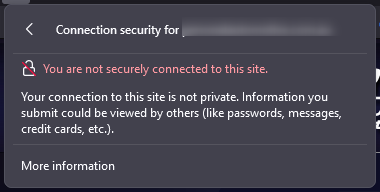
We'll explain the differences between "Free SSL" and "Dedicated SSL" Certificates in this article, which should help you decide which type of SSL Certificate is best for your website's security needs. Then, we'll assist you in installing cPanel's AutoSSL, a free SSL that is always enabled, so you can avoid browser warnings on your site.
Simply put, an SSL Certificate is a digital file that contains information used to authenticate the ownership of a website (or web server). It also includes a cryptographic key that has been supplied and authenticated by an authorised Certificate Authority (CA). This enables the visitor to quickly identify and trust a secure website.
This trust is represented by the more familiar "green padlock" displayed in the address bar. A green padlock (or, in some browsers, a solid, uncrossed padlock) indicates that the connection is properly encrypted for security.
In general, the two most widely accepted types of SSL are free SSLs and paid Dedicated SSL Certificates. In general, the encryption used by a Free SSL Certificate and a Dedicated SSL Certificate is the same.
What's the distinction? Without a dedicated IP address, free certificates use Server Name Indication (SNI). This means that multiple domains can use the same IP address while still using SSL. It should be noted that this type of certificate is not as widely accepted as an Advanced SSL with a dedicated IP address. This is since SNI is a relatively new extension that has only recently gained widespread support across browsers and devices. Some older browsers and devices may refuse to accept an SNI-enabled certificate.
Dedicated SSL Certificates frequently include more extensive validation. For example, an Extended Validation SSL Certificate would authenticate not only the domain owner but also the legitimacy of the business claiming to be the owner of the website. Although the encryption is the same, this additional layer of validation can help your visitors trust your website and business as a whole.
The level of acceptance provided by a free AutoSSL is adequate for most informational websites. Large-scale enterprises (such as an eCommerce store) that accept private data about their customers should consider purchasing a paid SSL certificate from a reputable certificate authority. In addition to being widely accepted in all browsers and devices, premium SSLs from certificate authorities frequently include support and warranties. This is why many payment processors insist on you purchasing specific, premium SSLs.
Hosting Australia offers a wide range of Premium rapidSSL’s that will be installed and managed by our support team. Check Out which SSL is best for your website HERE!
The below highlights some of the key differences between an AutoSSL and a purchased SSL, such as the popular RapidSSL
| Free AutoSSL Certificate | Purchased SSL Certificate |
| AutoSSL (cPanel, Comodo issued) certificate is valid for 90 days and renewed automatically in cPanel. More renewals, can mean more points of failure or issues. | Purchased SSL Certificates are valid for a minimum of 1 year. |
| AutoSSL Certificate doesn’t provide the site seal to display on your site and earn trust from your website users. | Purchased SSL Certificates provide a secured site seal for their SSL certificates, which earns the trust of your website visitors. |
| AutoSSL does not provide any kind of support - you will need to troubleshoot and manage as the end-user. | Most of the Purchased SSL Certificates provide customer support including sales, technical, and installation. |
| AutoSSL doesn't provide Organisation Validation (OV) and Extended Validation (EV). | Purchased SSL does provide Organisation Validation (OV) and Extended Validation (EV). |
| You can install an AutoSSL Certificate to secure your informative website or a blog. | If you are running your business, we recommend you to go with a Purchased Certificate as a more robust and trustworthy solution. |
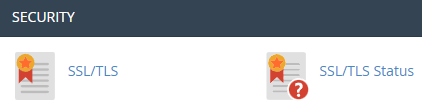
Hosting Australia's Core and higher hosting packages include a free autoSSL certificate. This autoSSL can be found in the SSL/TLS Status section of your cPanel, under the Security heading.
If you see a red padlock, it means your autoSSL is not installed. Simply check the box and run AutoSSL; after a few moments, a pop-up will
appear informing you that your auto-ssl has been installed.
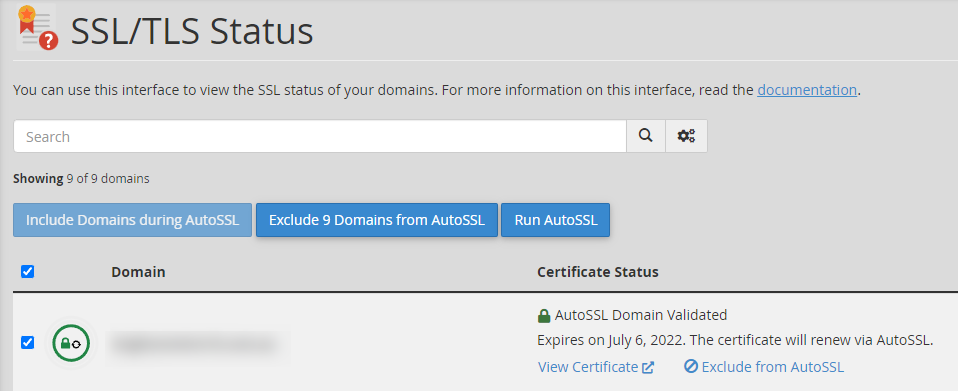
If you have any problems installing autoSSL, try troubleshooting using these methods.
To begin, ensure that your domain is pointed to our nameservers and eventually resolves to Hosting Australia's IP address. Check that your Content Delivery Network (CDN) is properly configured; some CDNs will require you to set up an SSL with them rather than with us. For more information on CDN-related errors, please see the section below. Here are some guides to help you ensure this is correctly configured.
Because your .htaccess file handles rewrite rules and redirects, it is frequently the source of Free SSL problems. .htaccess can be accessed through your File Manager; if you need help locating your File Manager, please see our guide HERE!
Because your plugins can modify the .htaccess file, they frequently cause conflicts. As a test, turn off any security plugins you're using.
When AutoSSL is enabled for an account and a domain or subdomain is added, the server initially generates a Self-Signed request and then works on obtaining an SSL certificate (based on Domain Name Validation).
[/et_pb_text][/et_pb_column][/et_pb_row][/et_pb_section]
Do you have a website and are getting the impression that it’s time to upgrade your hosting plan? Maybe you already know that you need to and you’re just waiting for the right moment to make the change. Maybe you’re not so sure about it. Whatever the reason for needing to upgrade your current hosting plan, you’re going to want to read on before making a final decision about whether or not you need to upgrade your current hosting plan. Hosting plays a critical role in the operation of your website. It’s the place where your site is stored and hosted. So, if you want your website to continue operating smoothly, you should make sure that you’re choosing the right hosting plan for your needs. Here are some of the signs that it’s time to upgrade your hosting plan.
Are you preparing to launch a new product? Are you allowing new members to join your membership site? Do you have a marketing campaign in the works that you're confident will be a success?
Make sure your website is prepared to handle more traffic than usual. The last thing you want prospective buyers, members, and social media followers to see is an error message—or a site that takes more than a few seconds to load.
If you're a new web designer or developer, you may have begun by adding your clients' domains to your shared hosting account. That might work for a while until it doesn't. If you manage numerous clients' domains from a single cPanel, you should consider upgrading your hosting package or transferring your clients to a reseller package.
Sites that load slowly are aggravating. If your site doesn't load in a few seconds, visitors are more likely to leave. In addition, if your site takes a long time to load, search engines will rank it lower in search results.
As a result, fewer individuals will be able to see what your website has to offer. If you've previously reviewed and optimised your basic web vitals, you might need to upgrade to a new hosting plan with faster server response times or a content delivery network to boost your site's speed.
Everybody appreciates enjoys a website with quality graphics, photos, and videos, and they all want them to load as soon as possible. It is best to optimise your images and videos for optimum functionality on your website. Compression and appropriate formatting can go a long way toward speeding up your site, but you may have more media than your current hosting package can manage at some point.
You might have come across the term “DNS TXT Record” as you browsed the web. If you haven’t heard about it before, you’ve probably come across a website that is using Text-Based DNS to work with their site. If you want to use this technique to work with your website, keep reading.
In this article, we will be discussing what a DNS TXT Record is, how it works, and examples of how you can use this record to work with your site. Keep reading to find out what a DNS TXT Record is, how it works and how you can use this record to work with your website.
A DNS TXT Record is a special type of DNS Record that is used to store extra data besides the standard DNS Record information. This record is stored in the DNS server and is accessible to the end-users of the DNS.
You can use the TLD (Top-level Domain) of the DNS server to define what type of data is stored in the TXT Record. Each TLD has a set of predefined TXT Records that you can use if you want to use a specific technique to work with your site.
For example, if you have a to validate your Domain name with Google and you are hosting with Hosting Australia, you can use Hosting Australia's DNS servers to create a DNS TXT record that points your Domain name to Google to validate your domain name.
TXT records can be used to ensure email security with the following records.
These records can be used to prevent phishing, spamming, and other malicious activity:
SPF is a standard email authentication method. SPF helps protect your domain against spoofing and helps prevent your outgoing messages from being marked as spam by receiving servers. SPF specifies the mail servers that are allowed to send emails for your domain. Receiving mail servers use SPF to verify that incoming messages that appear to come from your domain were sent by servers authorized by you.
| 2025.hosting-australia.com/ | TTL | Type | value: |
| 2025.hosting-australia.com/ | 3600 | TXT | v=spf1 ip4:192.243.61.237 ip6:2a05:d018:e3:8c00:bb71:dea8:8b83:851e |
DKIM Adds a digital signature to every outgoing message, which lets receiving servers verify the message actually came from your organization.
DKIM help's to protect your domain against spoofing and helps prevent your outgoing messages from being marked as spam. Spoofing is a type of email attack that forges the From address of an email message. A spoofed message appears to be from the impersonated organization or domain.
DKIM detects when a message has been modified, and when unauthorized changes are made to the message From: address.
Without DKIM, messages sent from your organization or domain are more likely to be marked as spam by receiving mail servers.
| 2025.hosting-australia.com/ | TTL | Type | value: |
| big-email._hosting-australia.com | 3600 | TXT | v=DKIM1; p=76E629F05F70 9EF665853333EEC3F5ADE69A 2362BECE4065 8267AB2FC3CB 6CBE |
DMARC: Let you tell receiving servers what to do with outgoing messages from your organization that doesn’t pass SPF or DKIM.
DMARC is a standard email authentication method. DMARC helps mail administrators prevent hackers and other attackers from spoofing their organization and domain. Spoofing is a type of attack in which the From address of an email message is forged. A spoofed message appears to be from the impersonated organization or domain.
DMARC also lets you request reports from email servers that get messages from your organization or domain. These reports have information to help you identify possible authentication issues and malicious activity for messages sent from your domain.
| 2025.hosting-australia.com/ | TTL | Type | value: |
| _dmarc.hosting-australia.com | 3600 | TXT | v=DMARC1;p=reject;pct=100;rua=mailto:postmaster@hosting-australia.com |
You can use TXT records to verify your domain with providers such as Microsoft, Google, Wix, Squarespace. This helps the provider find and validate the domain the provider gives you a record to add to your domain settings, when the provider sees that you’ve added the record, your domain ownership is confirmed and can allow other records to be added such as MX and CNAME.
| 2025.hosting-australia.com/ | TTL | Type | value: |
| businessmappingsolutions.com.au. | 3600 | TXT | google-gws-recovery-domain-verification=382251239 |